
Sakshi Sureban
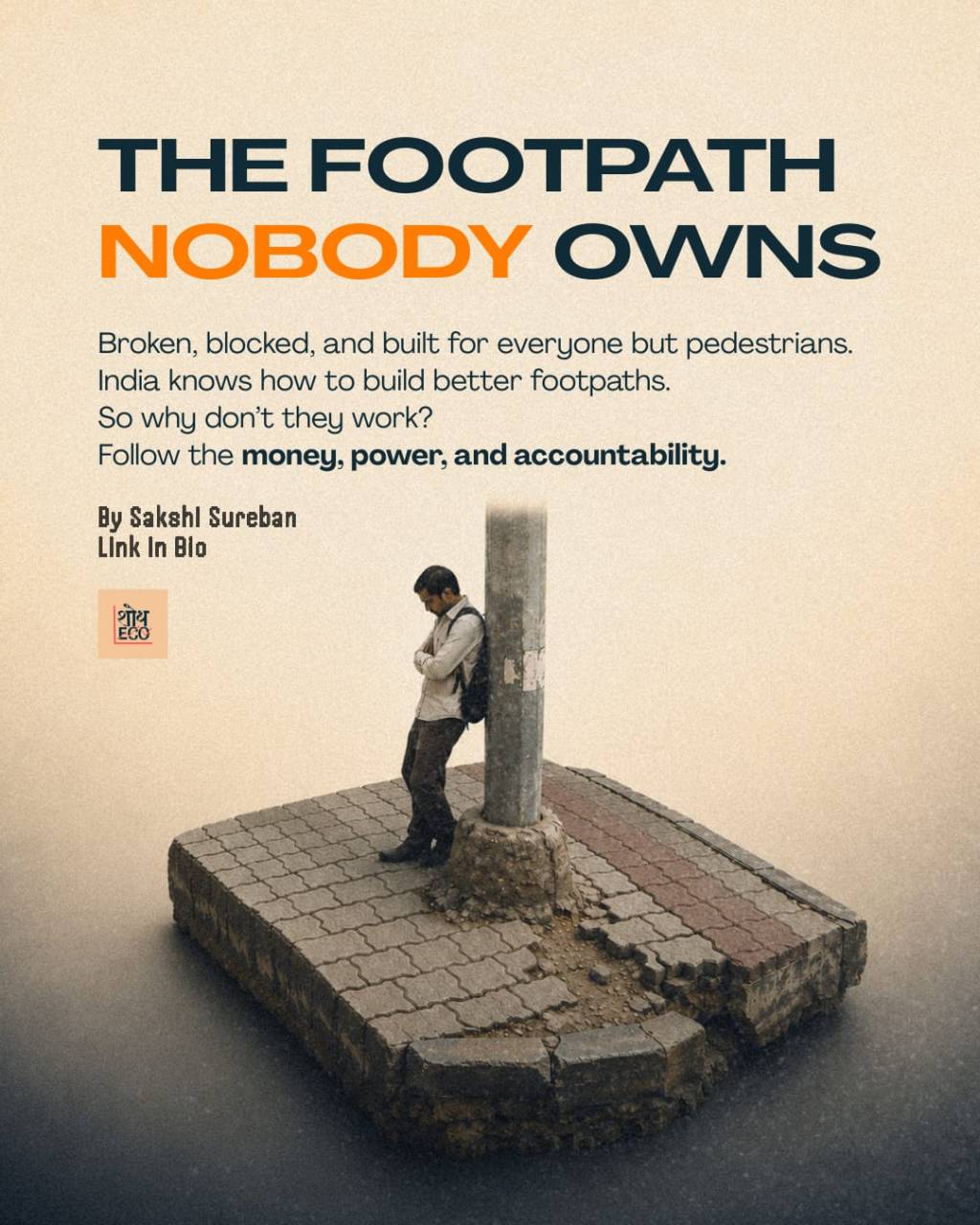
Walk down almost any street in urban India and you’ll notice a footpath, which isn’t really for pedestrians. It’s used for parking cars, bikes, setting unauthorised shops, dump garbage such as construction debris, or for housing an electricity pole planted dead in the middle of the walking zone. Pedestrians have no option but to use roads for walking, sharing space with buses and autos moving at very different speeds than they are. And this jeopardises the safety of pedestrians. This isn’t an accident of bad luck. It’s the predictable result of how footpaths get planned, funded and maintained in India. To understand why, it helps to picture the two extremes: the footpath as it usually is, and the footpath as it could be. Worst case: the footpath that isn’t one As a pedestrian it is an everyday struggle to reach the destination on foot. A stretch of footpath in a busy marketplace is almost invisible, it’s a about a meter wide in places, narrower where a transformer box eats into it, and it disappears entirely for fifty metres in front of a row of shops that have extended their frontage onto it. A two-wheeler is parked across what’s left. There’s no ramp where the footpath meets the road, so anyone with a stroller, a wheelchair, or just tired knees must step down onto the carriageway to get around the gap. At night, there’s no lighting to speak of. This isn’t a hypothetical worst case. It’s closer to the norm, and the data backs that up. Start with money. In Bengaluru’s Comprehensive Traffic and Transportation Study in 2010, which envisaged roughly USD 12 billion in transport investment over fifteen years, pedestrian projects got just 0.6% of the total budget, while 60% went to mass transport. And within that tiny 0.6%, threequarters was earmarked for overhead crossings, not footpaths. Overhead crossings, notably, are the facility pedestrians use least, because they’d rather cross at grade if there’s a safe way to do it. So even the sliver of the budget meant for pedestrians was aimed at the wrong thing. Then there’s the absence of any real standard to build to. There’s no national design standard that Indian cities are legally required to follow for footpaths. The IRC (Indian Roads Congress) publishes detailed guidelines, but guidelines aren’t law, and there’s no consequence for ignoring them. Janaagraha’s 2023 Annual Survey of India’s City-Systems found that no state or union territory in the country has mandated street and public space design standards for its cities. Without a floor to build above, footpath quality is left to whichever engineer or contractor happens to be doing the job that year. Planning documents make it worse by omission. City mobility plans and master plans in India are generally written around vehicle throughput and big-ticket transport infrastructure. Footpaths, as the Clean Air Asia review of Indian walkability policy points out, aren’t even classified as infrastructure under the Planning Commission’s definitions, which means they can fall out of project scope entirely before construction ever starts. Janaagraha’s survey adds that 39% of state capitals, including Delhi, Bengaluru, Bhopal, and Dehradun, don’t have an active master plan at all. And the institutions responsible for footpaths are in no shape to fix any of this. Urban local bodies (ULBs), the city governments that are supposed to build and maintain footpaths, are chronically under-resourced. The Comptroller and Auditor General (CAG) found that own-source revenue covers just 32% of total ULB revenue on average, with some states below 15%. Only 56% of the property tax actually owed to ULBs gets collected. During the 15th Finance Commission period, only 63% of the grants recommended for local bodies were actually released. On top of that, 1,600 of 2,625 ULBs audited by the CAG didn’t have an elected council at the time of the audit, and over 1,400 cities, including Bengaluru and Mumbai, have gone as long as nine years without an elected mayor or council. It’s hard to hold anyone accountable for a broken footpath when the body responsible for it barely has a functioning government or a budget of its own. Best case: what a footpath is supposed to do Now picture the same street with the footpath actually working the way it’s meant to. It’s at least 1.8 metres wide and clear of obstructions for its full width and to a height of 2.2 metres, so nothing, not a pole, not a tree branch, not a hoarding, intrudes into the space someone needs to walk through, including someone using a wheelchair or walking with a guide dog. Where the footpath meets the road, there’s a kerb ramp, not a step down, so continuity isn’t broken for anyone using mobility aids or pushing a pram. The kerb itself doesn’t exceed 150mm, the height of a standard step. Street furniture, benches, lighting, dustbins, is placed in a consistent line along one edge, out of the walking zone. There’s a bench every fifty metres or so for anyone who needs to rest. Streetlights are spaced every 20 to 30 metres and pointed down at the walkway, not the car lane. Where hawkers operate, and they will, because they’re a real part of how Indian streets function, they have a designated zone that’s part of the footpath’s design rather than an improvised encroachment fighting pedestrians for the same three feet of space. None of this is aspirational or imported. It’s already spelled out, in this level of detail, in the IRC’s Guidelines for Pedestrian Facilities and in city-level toolkits like Unified Traffic and Transportation Infrastructure (Planning & Engineering) Centre’s (UTTIPEC) Street Design Guidelines and the ITDP/EPC guide Better Streets, Better Cities. The knowledge of what a good footpath looks like isn’t the missing piece. What’s rarer is seeing it actually get built, and Tender Specifications for Urban Road Execution (S.U.R.E.) is the clearest proof that it’s possible. It’s a design, procurement, and implementation framework adopted in Karnataka starting in 2012–13, built around organised underground utility corridors (so the same stretch of road doesn’t get dug up repeatedly for water, sewage, and cabling), uniform lane widths, and continuous, even footpaths that don’t vanish at property lines. About 60km of Tender S.U.R.E. roads are complete in Bengaluru, and a monitoring study by Jana Urban Space Foundation (JUSP) found that respondents reported 63% greater ease of walkability and 54% greater ease of drivability on those roads compared to conventional ones. It’s since been extended, with roads underway in Hubballi-Dharwad, Chennai, Coimbatore, and Hyderabad, and Odisha has adapted its own version of the model. The gap between the worst case and the best case, in other words, isn’t a knowledge gap. It’s not that nobody knows what a good footpath looks like. It’s that the systems meant to deliver one are broken in specific, identifiable ways. Why the gap exists: finance, implementation, coordination, and ownership Four things are doing most of the damage, and they compound each other. Finance: Pedestrian infrastructure is chronically underfunded relative to vehicle infrastructure, and even the funding that does exist often goes to the wrong projects, as Bengaluru’s 0.6%-for-pedestrians, 75%-of-that-for-overhead-crossings allocation shows. This isn’t unique to one city. It reflects a planning culture where footpaths aren’t treated as infrastructure worth budgeting for on their own terms. The Fifteenth and Sixteenth Finance Commissions have tried to address this at the structural level, tying grant eligibility for states to things like minimum own-source revenue growth for ULBs, but the underlying problem, that city governments don’t generate or receive enough money to maintain what they build, remains largely unresolved. Poor implementation: Even when a footpath gets built to spec, there’s often no mechanism to keep it that way. As the earlier research bluntly puts it: the planning and structure of footpaths is often done adequately on paper, but officials forget to implement them properly, and the real problem is implementation, monitoring, and evaluation. A width standard on paper doesn’t stop encroachment once construction is done. A benchmarking tool that only tracks three indicators, signalised intersection delay, street lighting, and percentage of footpath wider than 1.2m, as Ministry of Urban Development’s (MoUD) tool does, can’t capture whether a footpath is actually usable day to day. You can’t manage what you don’t measure, and India measures walkability with a very blunt instrument. Poor coordination: Urban transport in Indian cities involves the transport department, police, urban development department, municipal corporation, revenue department, finance department, public works department, and pollution control board, often with no single body clearly in charge of pedestrian facilities specifically. National Urban Transport Policy (NUTP) 2014 recommended a three-tier institutional structure, with a unified metropolitan transport authority for intra-sectoral coordination, precisely because this fragmentation was already a known problem then. Two decades later, most cities still don’t have one. When seven agencies each have partial responsibility and none has full ownership, footpaths become the thing everyone can point to someone else about. Fragmented ownership: This is really the root of the other three. Depending on the road, a footpath might fall under the Ministry of Road Transport and Highways, the National Highway Authority, a state highway authority, the municipal corporation, a development authority, or a cantonment board. Constitutionally, urban development is a state subject, but state urban development authorities handle most of the planning while local governments, who have the least resources and the least authority, get stuck with maintenance. Legally speaking, walkability policy exists and even sounds reasonably progressive on paper. Meenakshi Singhal’s review of the legislative framework points out that recognition of pedestrian rights exists in policy, but implementation is described as half-hearted, and the overall framework is fragmented and disjointed. That’s the pattern across nearly every layer of this problem: the intent is there, sometimes even the design standard is there, but there’s no single accountable owner to see it through from planning to construction to upkeep. What this adds up to The worst-case footpath and the best-case footpath aren’t separated by an engineering problem. India has design standards detailed enough to specify kerb height in millimetres, and it has at least one large-scale proof of concept in Tender S.U.R.E. that shows the standards work when they’re actually followed. What separates the two is governance: footpaths sit at the bottom of a system where the body meant to build and maintain them has neither the power, the mandate, nor consistently even an elected leadership to do so. Closing that gap starts with strengthening ULBs as the accountable authority for urban streets, rather than leaving footpaths split across the Ministry of Road Transport and Highways, state highway authorities, development authorities, and cantonment boards depending on which road they happen to sit on. It means enforcing the constitutional requirement for timely municipal elections, since a city cannot be expected to plan or maintain its own footpaths when, as the CAG found, 1,600 of 2,625 ULBs audited lacked an elected council altogether, and some cities have gone nine years without one. It means backing that authority with real fiscal devolution, so ULBs aren’t dependent on inconsistent state transfers to fund something as basic as a continuous, obstruction-free footpath. And it means giving municipalities the actual freedom to design their own streets, IRC standards already exist in enough detail, but without statutory force and local design autonomy, they remain guidance a city can follow or ignore depending on the year and the contractor. None of this requires new evidence. It requires treating the footpath not as a construction line item but as a test of whether Indian cities have been handed the power to govern the space directly outside their own front doors.

