
Ved Shaha
The United Arab Emirates left OPEC and OPEC+ on May 1, 2026, citing the need to protect its national interests. UAE thinks that its national interests are better served by acting as an independent producer rather than being part of any cartel. In OPEC, the UAE was the third- largest producer and played a key role in managing global oil prices. According to many energy experts and news reports, this action had been discussed behind closed doors for many years due to the UAE’s growing rivalry with Saudi Arabia which is the de facto leader of the grouping. It is essential to note that the UAE is not the first country to leave OPEC. In recent years, countries such as Qatar and Ecuador have also left OPEC, citing nearly identical reasons. The move taken by the UAE is not just about Economics, but it also has a geopolitical angle. There are many converging reasons behind the decision by the UAE to leave OPEC, which I’ll discuss in this article one by one.
Production Quota and Energy Independence
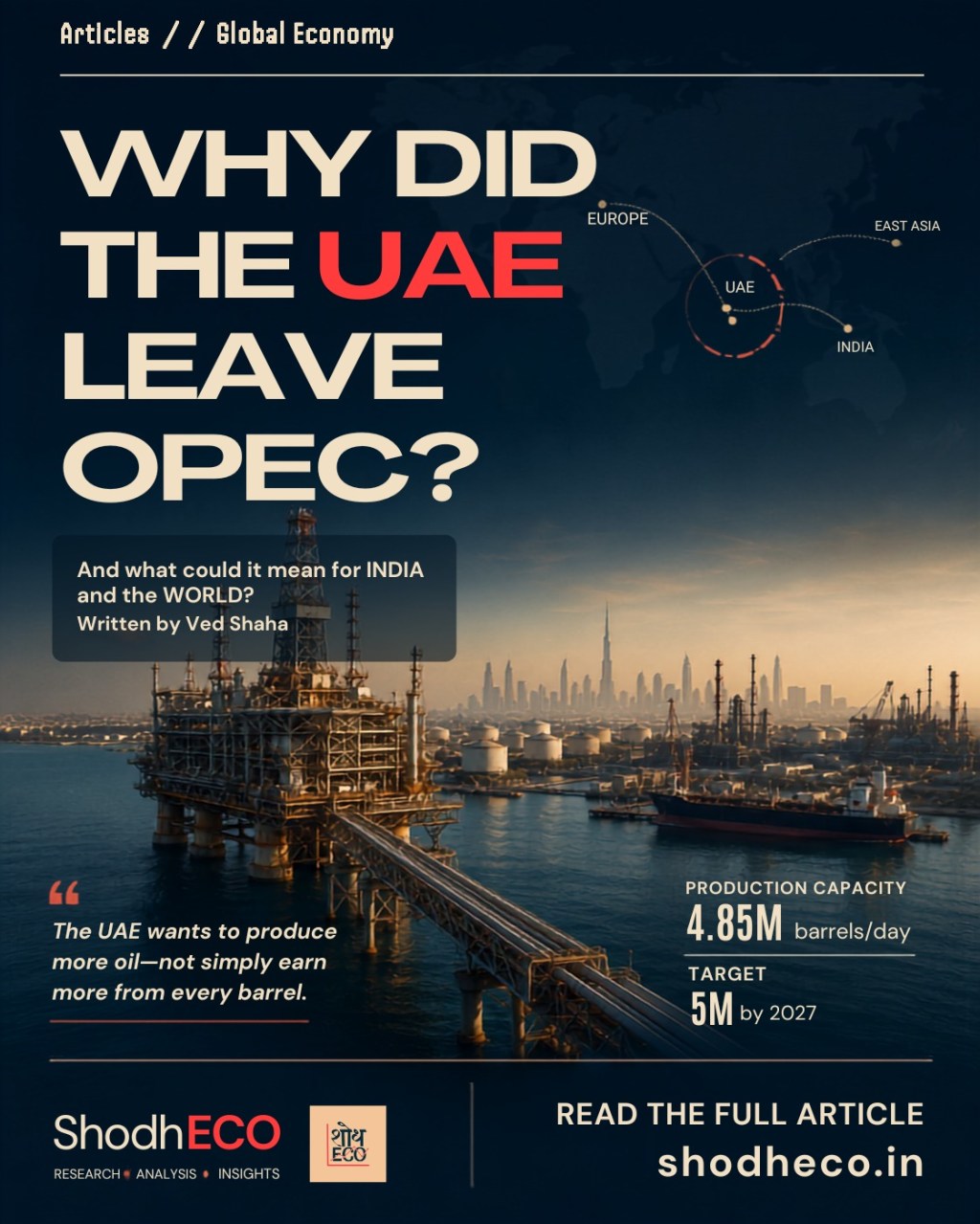
In OPEC and OPEC+, members have always agreed and also disagreed on production quotas/limits on oil production. However, this has not gone well with some countries like the UAE. The UAE has a lot of spare capacity, which means it can supply a lot of oil to the market during emergency times unlike other countries. As of today, the UAE has the capacity to produce 4.85 million bpd and is actively expanding this capacity, with goals to reach 5 million bpd by 2027. But under the production quota system, the production was restricted to 3.2- 3.5 million bpd. So a country that has so much potential and has invested a lot of capital in developing and improving the oil sector for so many years, being bound by production quotas is like punishing itself. Countries like Saudi Arabia have always pushed for production quotas in order to benefit from higher oil prices. But in the case of the UAE, economics does not work that way. The cost of production for producing oil is very low in the UAE compared to other countries. So the UAE does not need higher oil prices like over $70-100$ a barrel to sustain its economy. So, though the price of oil per barrel is low, say 60$, the UAE gains by selling more additional output earning more revenue. Speaking in business terms, this helps the UAE to increase its market share. So, it’s just different economic models. Overall the UAE also thought that there was a clear lack of unity within OPEC to manage oil prices, for instance the price war between Saudi Arabia and Russia in 2018.
Clear Vision and Understanding of the World
The UAE knows that global oil demand is going to become weaker in the coming years due to the rise of renewable energy. So it is capitalising on how much it can in the present time. It is also an opportunity for the UAE to use this excessive revenue to fund its ”Net Zero Strategy 2050.”Leaving OPEC allows the UAE to take all these decisions independently without any outside pressure. So in a way, the UAE is acting as a responsible nation by supplying the undersupplied oil market which in turn also helps the global economy amid global volatility.
Growing Rivalry with Saudi Arabia and Geopolitical Tensions
UAE and Saudi Arabia have been at odds with each other due to differences over Sudan, Yemen and the Iran War. In Sudan and Yemen, both nations back opposing separatist groups hence exacerbating the problem. The UAE was the single most heavily affected country and victim of Iranian retaliatory strikes on its neighbouring countries. Its ports and International Airport came under heavy attacks during the war affecting its economy and status. According to the UAE, Saudi Arabia and other Arab countries did not do enough to support the Emirates, they did not offer political and military support except for solidarity, which the UAE did not like. Furthermore, in recent years, the UAE has become a close and trusted partner of Israel, creating friction between the two countries as Saudi Arabia has still not normalised its relations with the State of Israel due to the issue of the creation of Palestine State. UAE’s OPEC exit is also a signal to Russia which is a member of OPEC+ and a close friend and partner of Iran.
Increasing Convergence with the U.S. and Israel
In recent years, the UAE and the U.S. have seen increased economic and defence cooperation. So the timing of the exit offers an interesting perspective as the U.S. declared the UAE a major defence partner in 2024. In April 2026, the U.S. under the Trump administration announced a currency swap line to the United Arab Emirates to ensure liquidity and its financial stability. So the decision to leave OPEC was a quid pro quo agreement, with the U.S. supporting the UAE financially, which has suffered a lot due to the war in Iran and Oil prices becoming lower due to the abundant supply by the UAE after leaving OPEC which really helps the U.S. as oil prices have skyrocketed all over the world especially in the U.S. which imports a huge amount of crude oil. At the same time, the relationship between the UAE and Israel has also become very robust. It was widely reported that during the Iran War, Israel helped the UAE by sending Iron Dome batteries and providing intel and personnel as well.
Impact on India and the World
It can be said that OPEC may lose some market power and the collective bargaining mechanism due to the UAE’s exit, which could affect the grouping in the medium to long term. Speaking about the impact of the UAE’s OPEC exit on India, the move is very beneficial to India. As one of the world’s largest oil importers, India benefits from a likely oil glut as the UAE boosts production. It will also lead to lower import costs and inflation. The relationship and alignment between the two countries will only grow stronger which is also beneficial to the populace of both countries. However, India must balance its relationship with Saudi Arabia which is also an important partner in the Middle East. The exit may also prompt OPEC to reassess its efficiency and effectiveness.

