
Shantanu Morankar
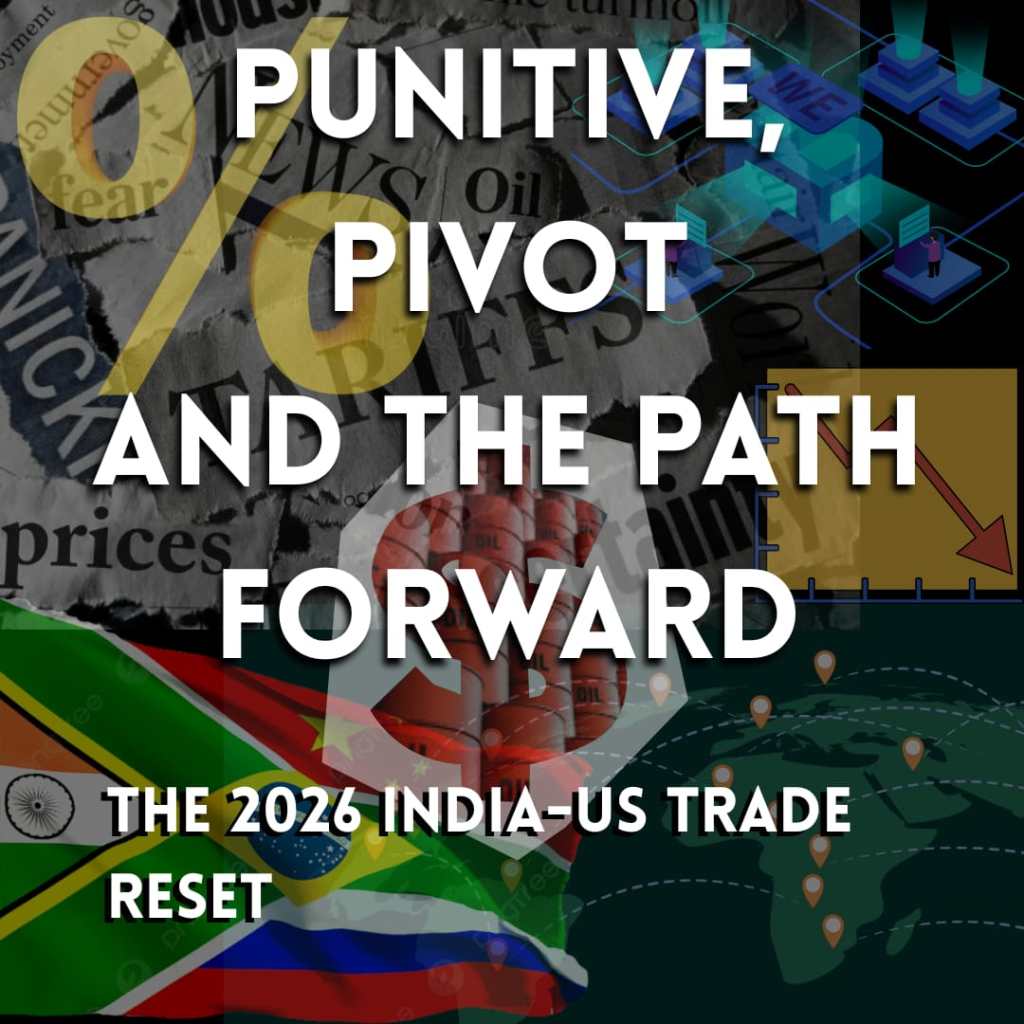
The United States and India have finally pressed the ‘reset’ button following months of crippling trade negotiations. The US has drastically reduced its duties on Indian goods from a whopping 50% to 18%. The agreement maintains India as a key ally of the United States and represents a strategic de-escalation of economic tensions. But what role does the agreement play for India, and what does it indicate in light of the growing de-dollarization efforts?
After nearly a year of transactional diplomacy, the two nations released a Joint Statement on February 6, 2026, detailing the terms of an Interim Agreement. The US lowered its tariffs on Indian imports from 50% to 18%, which included the 25% reciprocal duty and the additional 25% punitive tariff (imposed in August 2025 because of India’s purchase of Russian oil), as part of the agreement. President Trump agreed to lift the punitive tariffs, contingent on India’s commitment to discontinue buying Russian crude oil and to shift its energy procurement to the United States and, possibly, Venezuela. In exchange, New Delhi will likely reduce tariffs on US industrial imports, as well as a wide range of agricultural and food products. A fact sheet detailing the “path forward” for the recently finalized “historic trade deal” was then released by Washington. However, the US later amended the factsheet, substituting the word “committed” with “intends”, in both the factsheet and the joint statement, to emphasize the provision’s non-binding nature.
For India, the 18% drop restores competitiveness for its exporters. It is anticipated that industries such as textiles, clothing, and pharmaceuticals will experience an instant boost in demand. The agreement mitigates the immediate risk of a trade war, which should stabilize the Rupee and attract foreign direct investment (FDI) to Indian manufacturing. As for the United States, the deal allows US corporations to enter India’s nuclear power sector and defence production, while the US energy sector (oil, LNG, coal) obtains a large, long-term consumer, among other things.
However, the ‘reciprocal’ character of the agreement presumably implies that the US now sees India solely through a transactional lens. Also, since the agreement depends on India stopping Russian oil imports, it might put New Delhi’s ties with Moscow under pressure, which remains India’s biggest defence supplier. Furthermore, allowing heavily subsidized US agricultural products into India’s dairy and poultry industries may potentially lead to significant rural unrest and farmer protests. Shashi Tharoor, the Congress MP from Thiruvananthapuram, consequently questioned the Interim Agreement. The MP said that the pact “looks less like a free trade arrangement and more like a pre-committed purchase agreement that overturns every principle of reciprocity,” sparking a discussion on the Union Budget in the Lok Sabha. With bilateral trade currently sitting at $130 billion with a trade surplus of about $45 billion, he argued that the agreement essentially turns a surplus into a long-term deficit by pledging to purchase $500 billion worth of American goods over five years.
Nonetheless, this domestic tension highlights the friction between India’s immediate need for U.S. market access and the expanding global movement to diversify away from the American-led financial order. The deal comes amid accelerating de-dollarization trends through local currency commerce, the New Development Bank (NDB), and blockchain payment options that the BRICS countries are considering. De-dollarization is the process of replacing the US dollar with other currencies or assets for international transactions, commodity trading, and reserve holdings in order to reduce the US dollar’s dominance in international trade, finance, and foreign exchange (forex) reserves. Although de-dollarization encourages the use of multiple currencies, lessens reliance on a single currency, and balances global finance, it also raises the possibility of increased geopolitical tensions since the US may react aggressively by intensifying trade wars or sanctions against countries attempting to reduce dollar dependency. India participates in BRICS+ currency talks but maintains its caution, stating that it has no intention of undermining the US dollar as it views it as essential to maintaining global stability by striking a balance between short-term economic goals and long-term strategic interests. S. Jaishankar, the Minister of External Affairs, has also underlined that de-dollarization is not a part of India’s agenda, stating that the country needs to maintain close ties with the US, a major trading partner.
Although the recently agreed framework’s implementation will likely begin in the coming weeks, India must complete the Bilateral Trade Agreement (BTA) to reduce trade tensions and enhance supply chain integration, in an effort to draw in investment. To diversify export markets, New Delhi should accelerate Free Trade Agreements (FTAs) with the Gulf and East Asian blocs, acknowledge the cost of alignment in shifting crude sourcing from Russia to the US, and carefully gauge the ‘zero-tariff’ commitment to prevent US imports from flooding Indian markets.
Ultimately, the 18% tariff reset is less a permanent peace and more a ‘strategic window.’ The deal forces New Delhi to play a sophisticated double game: honouring a transactional partnership with Washington while maintaining its voice within BRICS+. India’s success will be measured by its ability to turn this American favour into a permanent foundation for Atmanirbhar Bharat, ensuring that when the geopolitical winds shift again, the nation remains firm.

