Author: Harshada Abhyankar
Reena couldn’t reach Jammu from Pune for voting in phase 2 due to her master’s exams.Kapoors planned a trip to the USA accommodating their son’s summer holidays and decided to skip on voting in the third phase of 2024 happening in May. Vaishnavi will not be able to vote as Gorakhpur goes fo elections in the last phase and she would be interning in Delhi during that time.
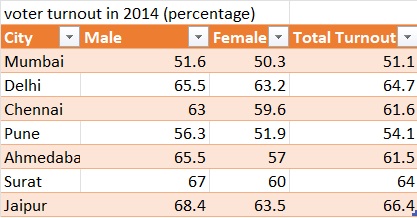
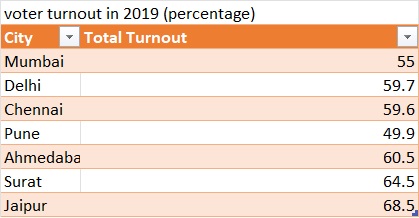
These narratives have become usual as far as the urban voters in India are considered. Since 2009, it has been observed and represented statistically that voter turn out in urban areas- tier 1 and tier 2 cities has been declining with every election. The Election commission of India needs to take double campaigning efforts in cities and urban conglomerations than in rural areas. Post the elections in Banglore in phase 2 of 2024 Loksabha elections, the ECI has issued pleas to level up the campaigning strategies in other urban areas through the next phases as Banglore for it’s 3 loksabha constituencies recorded only a little above 50% of voters’ turnout.
The data charts below represent the voters’ turnout across LokSabha elections in tier 1 and tier 2 cities in India.
But the question we need to delve into is why is the urban voter choosing not to vote? The humanities and social sciences literature discussing the low voter turnout voice the increasing apathy towards the political representation and occurence of indifference towards government and its actions, inactions. Contradicting this view, few others state that the cumulative impact of high number of migrants dwelling into the urban areas is being reflected on the low voters’ turnout.
But with innumerable conversations across citizens’ platforms, neighbourhoods in Pune, two reasons are found to be frequently surfacing. Firstly,to an extent the urban lower and upper middle class appear lowly satisfied with state provided services and provisions. The challenges emerging in day to day lives due to disorganised urban governance and unplanned urbanisation are affecting their standards of living and escalating hassles. This to an extent is seen reflecting in voters’ turnout. Secondly, the voters appear to prefer pressing NOTA or not going for voting all together due to snowballing discontent and fatigue as a result of constantly altering political landscape, emerging and confusing coalitions and ‘yutis’, blurring ideologies etc . The intensifying apathy is a result of feeling of being neglected,taken for granted through governance which is contemplated upon through low turnout.
The technical errors and inefficiencies exhibited in the system of elections also exhibit an effect to an extent. The list of missing names, deleted names, delays in additions of new names to the electoral list, lags in issuing of new voter identity cards and missing out on covering those carrying electoral card with 11 digit number in digitization process are critical as well to address low voter turnout.
Rather than adopting campaigning and nudge strategies to increase the voters’ turnout, prolonged process of augmenting trust in the government, governance and overall democracy is necessary. The lower turnout invariably impacts the government formation as few sections of the society don’t form the part of consensus. Democracy is about consensus building and consensus building is by faith, cooperation and empathy and not apathy. Apathy will eventually distance a class of voters from the democratic process overall.

