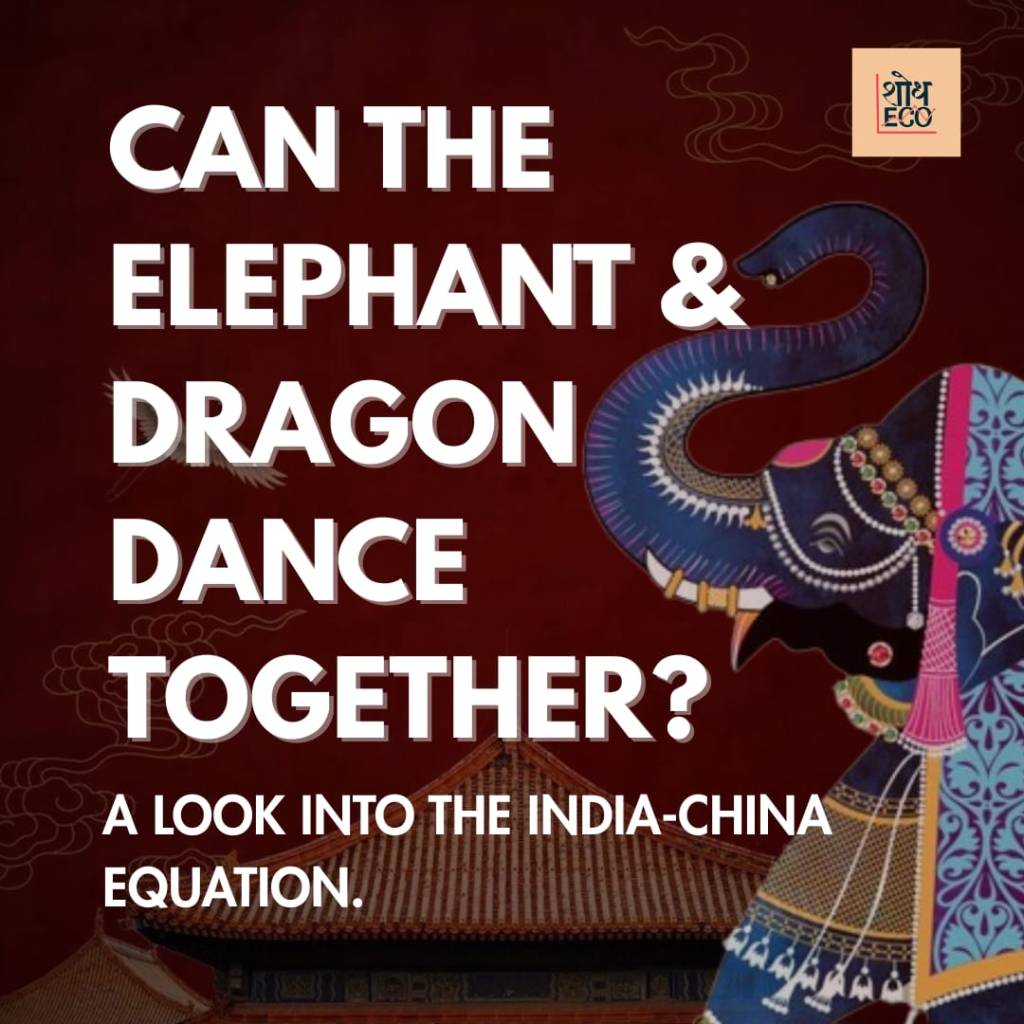

Amidst the unexpected tensions in India-US ties sparked by US President Donald Trump’s trade tariffs on India, the recently concluded bilateral meeting between Prime Minister Narendra Modi and Chinese President Xi Jinping on the sidelines of the SCO summit in Tianjin is considered a significant development in the relations between the two Asian giants.
Over the centuries…
India-China relations stretch back thousands of years. The inhabitants of the Indus Valley Civilization are thought to have enjoyed prosperous trade links with their Chinese counterparts. It was through Buddhist monks and traders that Buddhism spread from India to China. Post-independence in 1950, India was the first nation outside the socialist bloc to establish diplomatic relations with China. In the Nehruvian era, India consistently backed China, as shown by the fact that India proposed the entry of the People’s Republic of China into the UN. Later on, ‘Panchsheel’, or the Five Principles of Peaceful Coexistence, were publicly stated in the 1954 India-China Agreement on Tibet. Despite this, the 1962 Sino-Indian War broke out due to the border dispute between Aksai Chin and Arunachal Pradesh. The conflict resulted in a major setback to the bilateral ties. In 1988, the Indian government, under the leadership of Prime Minister Rajiv Gandhi, made efforts to restore relations by promoting trade, cultural exchanges, and people-to-people connections.
Contemporary Ties
From 1988 until 2020, despite border disputes and occasional military stand-offs, India and China were able to preserve peaceful trade and diplomatic relations. The 2017 Doklam stand-off and the Galwan Valley clash in 2020, which resulted in casualties on both sides, struck a significant blow to the equilibrium. For the first time since 1975, Indian and Chinese soldiers had lost their lives in a direct confrontation. As an immediate response, the Indian government halted Chinese investment in India. Cut to 2024, an agreement was reached for withdrawal in border areas related to the 2020 conflict, indicating a thaw. Since then, measures such as reopening the Kailash Mansarovar Yatra in Tibet, easing visa processes, and resuming high-level ministerial visits have contributed to normalization.
Tariffs, Tianjin, and thereafter
Although Indian officials have denied that the current improvement in relations is a response to US President Donald Trump’s tariff threats, analysts claim that Trump’s policies and the strained India-US relations are pushing New Delhi closer to Beijing. Others argue that India’s economic needs are driving the engagement. In any case, China, India’s largest neighbour, plays an important role as a crucial trading partner, supplier of critical components for strategic sectors, and collaborator on climate change. In the Tianjin meeting, the two leaders highlighted “with satisfaction the successful disengagement last year and the maintenance of peace and tranquility along the border areas since then.” China emphasized the Five Principles of Peaceful Coexistence, or Panchsheel, and stated that the nations must “firmly grasp” that they were “partners and not rivals.” For its part, the Indian side underlined the importance of mutual respect, interest, and sensitivity. As External Affairs Minister S. Jaishankar has observed, “the pre-requisite for an Asian Century is an India and China coming together.”
Globally, China’s economy is already in competition with that of developed democracies. It has become an economic superpower and is rivalling the United States of America on nearly every significant international stage. On the other hand, India, a vibrant democracy, is experiencing the fastest growth rate among major economies and is emerging as a global leader in advanced energy solutions. In this age of great power competition and geo-economic turmoil, India’s history with China should be viewed with caution, but it should not hinder the pursuit of opportunities wherever possible. Resolving the Sino-Indian border dispute will be critical for India as it seeks to reposition itself in Asia and even influence the emerging global order.
To address the central question, and as former diplomat and Parliamentarian Shashi Tharoor has noted earlier, ‘the elephant and dragon are already dancing together’. The sole concern that remains is how long this dance will last. Only time can tell.
 ShodhEco