
Understanding the exact problem is essential before exploring ways to unlock the potential of the informal sector.
The informal sector in India comprises a significant part of the workforce engaged in agriculture, street vending, construction, domestic work, and other unregistered occupations. Workers here typically face low income security, job instability, and lack of legal protections. Before exploring solutions, it is vital to understand the problem.
What is the Informal Sector?
The informal sector refers to workers primarily involved in self-employment and casual labour without formal contracts, social security benefits, or regulatory oversight. This includes small-scale and household enterprises.
What Does the Data Say?
As per the Periodic Labor Force Survey ( 2023-24), nearly 90% of India’s workforce is informal, with the majority being self-employed.
In rural areas: 59.4% of men and 73.5% of women are self-employed.
In urban areas: 39.8% of men and 42.3% of women are self-employed.
Other Relevant Numbers –
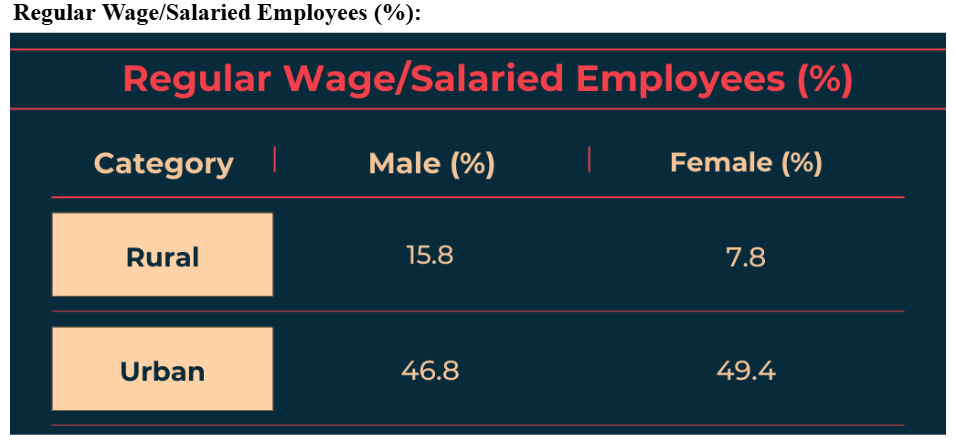
Regular Wage/Salaried Employees (%):
Casual Labour (%):
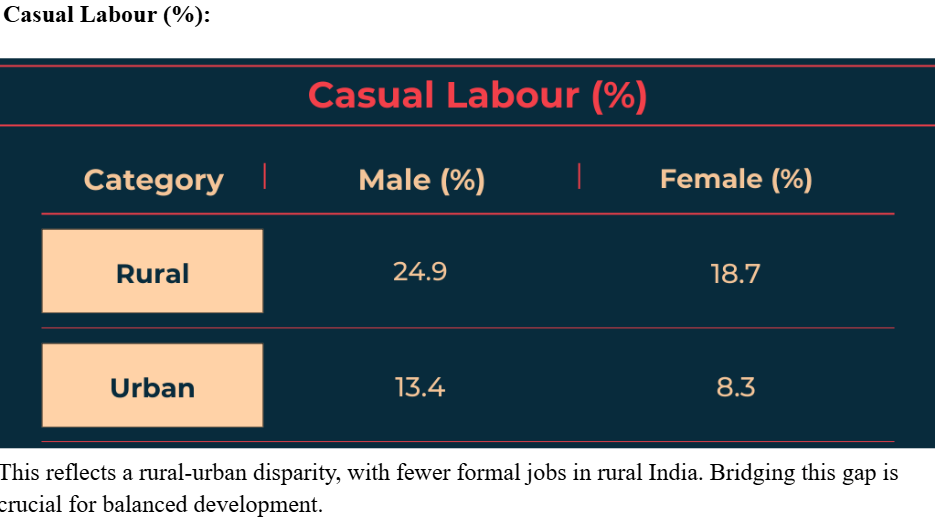
This reflects a rural-urban disparity, with fewer formal jobs in rural India. Bridging this gap is crucial for balanced development.
But, actually formalizing the Informal Sector Necessary?
Absolutely. Without formalization, workers remain trapped in poverty, insecurity, and exploitation. A formal workforce not only enhances individual welfare and social stability but also fuels national economic growth.
What is the potential of our informal sector?
1)Women Empowerment:
About 92% of Indian working women are in the informal sector, often earning low wages and lacking social security. Formalizing women’s employment can elevate their income, status, and contribute significantly to GDP.
2)Economic Growth & Sustainable Development:
The service sector, despite contributing most to GDP, employs fewer workers compared to agriculture. Formalizing the informal sector can enhance productivity, skill levels, and unlock growth in green industries like recycling, organic farming, and solar energy.
3)Social Benefits:
The formal sector ensures social security, job stability, and reduces income inequality, improving standards of living. Greater formalization can also boost India’s ranking on the Global Happiness Index, where India stands at 118th out of 147 countries.
4)Voice of Labour:
Formalization strengthens the bargaining power of workers to demand better wages and conditions.
5)Technological Inclusion:
In the era of Artificial Intelligence and Digital India, formalization ensures more people are educated, skilled, and digitally literate, enabling their participation in the digital economy.
We must now ask — what barriers are keeping the informal sector from transforming into India’s growth engine?
1)Low Labour Force Participation Rate (LFPR):
India’s overall LFPR is 45.1%, with female LFPR even lower — 35.5% in rural and 22.3% in urban areas — indicating a vast untapped workforce.
2)Skill Deficit:
Most informal workers lack formal education and skills, limiting productivity and formal employment opportunities.
3)Limited Access to Credit:
Self-employed and informal workers face strict eligibility criteria and lack collateral, restricting their access to bank credit essential for business growth.
4)Regulatory Constraints:
Complex compliance requirements deter small units from formalizing due to costs and bureaucracy.
5)Vulnerability to Shocks:
The informal sector is highly vulnerable to economic downturns, pandemics, and natural disasters, with little resilience to recover.
6)Poor Working Conditions:
Workers face unsafe environments and unstable incomes, reducing productivity and trapping them in poverty cycles.
Are Solutions Straightforward?
While solutions exist, they come with inherent complexities, often creating policy traps. Let’s understand this through a conversation:
Sumit: We can tackle these problems by launching large-scale skill development programs, providing easy credit access, and incentivizing formal sector jobs.
Sajid: It’s not that simple Sumit . India has a massive youth population, yet the LFPR for ages 15-29 is just 46.5% (PLFS 2023-24). Skilling such a large base demands enormous financial and institutional resources, which is challenging for a lower-middle-income country like India.
Sumit: then, how do other countries like Japan, Germany, etc. achieve this milestone? They were also developing countries like India
Sajid: Moreover, countries like Germany or Japan formalized due to early industrialization, smaller populations, and no colonial exploitation — unlike India, which suffered two centuries of colonial drain, a population explosion in the 1980s, and limited per capita investment in education and health.
Sumit: But if we expand credit and skill programs, can’t we still improve?
Sajid: Yes, but with caution. Expanding credit without proper monitoring risks defaults. Mass skilling must align with market demands to avoid producing educated but unemployed youth — a reality already visible with 7.1% unemployment among educated persons aged 15+ (PLFS 2023-24).
Thus, while formalization is essential, it must be backed by systemic reforms, targeted investments, and careful policy design to avoid creating new economic and social challenges.
 ShodhEco