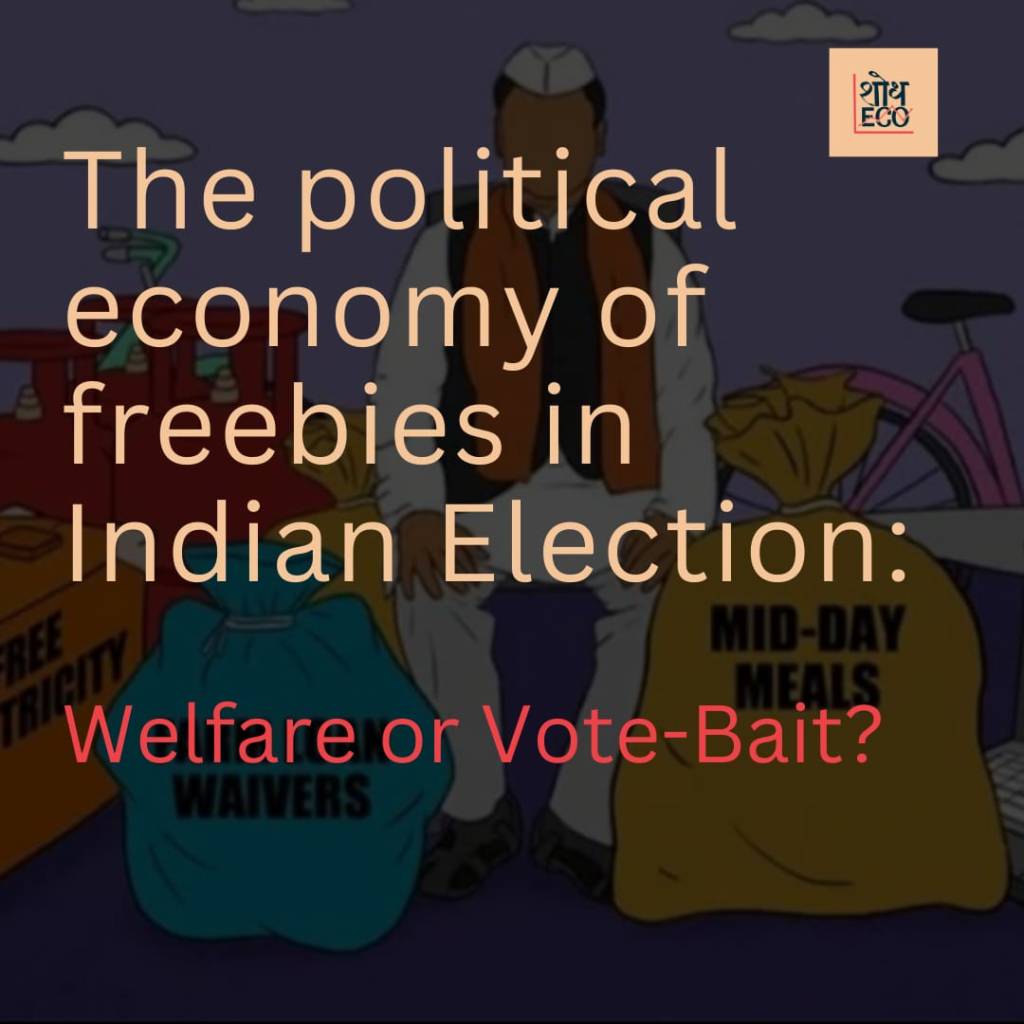

Freebie, according to the dictionary, is something you are given for free, a benefit provided free of cost and the RBI definition is ‘public welfare measure that is provided free of charge’. Technically nothing is ever truly free; there is always some price to pay. Price not in terms of money still counts as price, for instance voting for the party providing the freebies, giving up something of ownership or favours. Freebies were metaphorically termed as Rewadi culture by our Prime Minister first in 2022. Rewadi is a type of sweet that is distributed among masses during festivals and celebrations. It is a political handout meant to entice voters. While some freebies act as essential welfare measures, others function more as political tools that risk long term economic harm.
There are advantages and disadvantages of freebies as well. On one hand it increases productivity leading to faster economic development, it creates chances for equal pay, it provides basic necessities and social welfare to the marginalized sections, but on the other hand it increases dependency on the government, it becomes a fiscal burden, it increases overconsumption which might lead to negative impact on environment, etc.
Some well known examples of Freebies across the nation are The Ladki Bahin Yojna by the BJP, Free electricity and water in Delhi by AAP, Colour TVs in Tamil Nadu by DMK, Free Housing (PMAY) by BJP, etc. Given below is how much these schemes affected the state budgets:

There is a difference between welfare policies and freebies. Welfare is defined as the overall well-being of individuals and society, often measured in terms of material goods and services. Welfare policies – such as free public services in education and health – are meant for all sections of society and are included in the state budget and government programmes; whereas the freebies are aimed at those masses who are basically the vote banks. Maximum times welfare schemes have a positive impact, whereas freebies cause some amount of positive impact but creates more distortions, dependency and strain on other resources.
Another layer to the discussion is the political incentive structure that encourages the rise of freebies. In a highly competitive electoral environment like India, where voter loyalty often hinges on immediate benefits rather than long-term policy vision, political parties across the spectrum are incentivized to promise material goods or subsidies. These handouts are often framed as acts of empowerment, but in many cases, they are introduced without a sustainable financial roadmap.
What complicates the matter further is the lack of a legal or institutional framework that distinguishes legitimate welfare from fiscally irresponsible freebie distribution. Although the Supreme Court of India has raised concerns over pre-election freebie announcements, and the Election Commission has occasionally issued notices to parties, there remains a grey area regarding enforcement. This absence of regulation enables political parties to exploit public sentiment for short-term gains, sometimes at the cost of long-term fiscal stability.
In many instances, funds for freebie schemes are reallocated from essential sectors such as health, education, rural development, or capital infrastructure. This leads to an opportunity cost, where important public services suffer due to diversion of limited resources. Over time, this may widen inequalities instead of reducing them, as these schemes often miss the most marginalized who are either unaware of or excluded from implementation processes.
Moreover, the expectation of continuous handouts creates a vicious cycle. Voters begin to associate electoral promises with direct cash or in-kind transfers, pressuring future governments to maintain or expand such schemes regardless of fiscal space. This not only reduces accountability on governance metrics but also pushes the states toward increased borrowing and widening revenue deficits.
To break this cycle, there needs to be a transparent cost-benefit analysis of all major welfare and subsidy schemes. Governments must also publish clear fiscal impact assessments and outline whether funding is backed by revenue streams or debt. Without such measures, the economics of freebies may remain politically rewarding, but economically destabilizing.
 ShodhEco