
The state of Maharashtra has undertaken significant strides in institutionalizing social audits
as a mechanism to enhance transparency, accountability, and participatory
governance—especially in the implementation of rural welfare schemes such as the
Mahatma Gandhi National Rural Employment Guarantee Scheme (MGNREGS). Social
audits function as participatory tools, empowering citizens to assess the delivery and
effectiveness of government programs and ensure public resources are used responsibly.
The Maharashtra State Society for Social Audit and Transparency (MS-SSAT) was formally
established in January 2018 to operationalize the social audit process as per the mandates
under Section 17 of the MGNREGA Act. However, the older Directorate of Social Audit
under the Employment Guarantee Scheme (EGS) Department still operates in parallel,
leading to administrative overlaps and delayed transfer of responsibilities. This dual
structure, along with a shortage of trained personnel and inadequate financial autonomy,
continues to hinder the efficacy of Maharashtra’s social audit system.
Audit Process and Coverage
In Maharashtra, the social audit of one Gram Panchayat (GP) typically spans five days,
involving approximately three Village Resource Persons (VRPs), adjusted based on
habitation size, terrain, and job card numbers. Audits are conducted simultaneously in 20
GPs per block, supported by 60 VRPs, 5 Cluster Resource Persons (CRPs), one Block
Resource Person (BRP), and overseen by a District Resource Person (DRP). State
Resource Persons (SRPs) monitor multiple DRPs and ensure coordination with district
officials. VRPs are required to stay in the GP during the audit, lodging in public buildings like
GP offices or schools. While audits are meant to be held biannually in every GP, actual
coverage has been inconsistent. Between 2019 and 2024, Maharashtra’s 27,882 GPs saw
highly uneven audit frequencies across districts. For instance, districts like Gadchiroli and
Nashik reported high audit coverage, whereas others such as Palghar, Parbhani, and
Raigad witnessed near-zero activity in recent years.
Graph 1: District-wise Social Audit Coverage in Maharashtra (2019-2024)
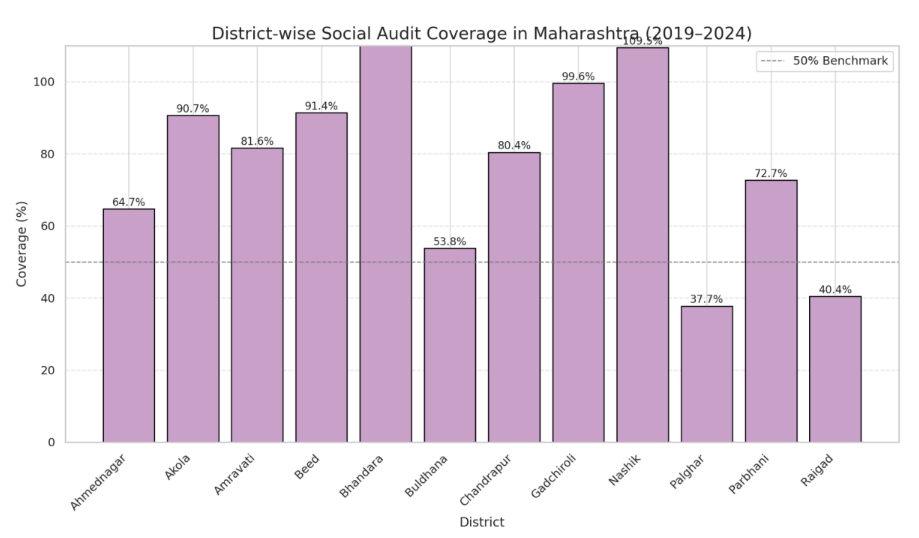
Data reflects total audits conducted per year; repeated audits of the same GP may inflate
total count.
The average cost of conducting a social audit per GP is approximately ₹15,000, which
covers the logistics, personnel honoraria, and documentation. However, inadequate
resource allocation and limited staff capacity remain persistent challenges.
Audits have revealed numerous irregularities, including missing saplings, fake invoices,
incomplete works, and payments made to non-workers. Unfortunately, financial
misappropriation often goes unquantified, and delays in payments—especially for skilled
labor—remain common grievances.
Follow-up mechanisms have been formalized through monthly review meetings with District
Collectors. However, many of these efforts are constrained by delayed submission of Action
Taken Reports (ATRs), non-cooperation by local officials, and poor integration with grievance
redressal systems.
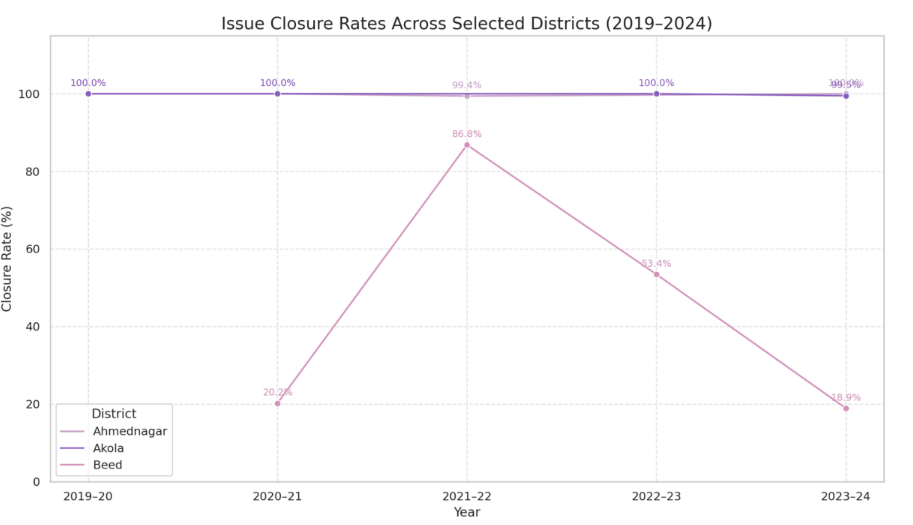
From 2019 to 2024, despite thousands of issues being reported, the issue closure rates
varied dramatically. Districts like Ahmednagar and Akola demonstrated near-perfect
follow-up, while Beed had a closure rate of just 18.89% in 2023-24, reflecting a troubling gap
between detection and resolution.
Graph 2: Issue Closure Rates Across Ahmednagar, Akola and Beed (2019-2024)
While the primary focus has been on MGNREGS, Maharashtra has also piloted audits for
other welfare programs like the Pradhan Mantri Awas Yojana (PMAY) and the National
Social Assistance Programme (NSAP). These initiatives indicate potential for expanding the
scope of audits to a broader array of schemes, though scaling efforts are still nascent.
Key Challenges and the Way Forward
The state’s social audit system faces multiple systemic hurdles: lack of autonomy for
MS-SSAT, poor integration of findings into policy reform, delayed recruitment of trained
personnel, and insufficient funding. Furthermore, the dependence on VRPs—often
undertrained and inadequately supported—compromises the quality of audits.
To strengthen the social audit system, Maharashtra can:
● Streamline institutional structures by formally consolidating MS-SSAT’s authority.
● Invest in capacity building and training for audit personnel.
● Ensure transparent publication of findings and actionable follow-ups.
● Expand audits beyond MGNREGS to other critical rural and social welfare programs.
In conclusion, while Maharashtra has taken commendable steps in embedding social audits
into its governance framework, much work remains. With stronger implementation, greater
political will, and community engagement, social audits can evolve into powerful tools for
grassroots democracy and inclusive development.
First Author- Gargi Phadnis
Second Author- Ananya Sonavane
 ShodhEco