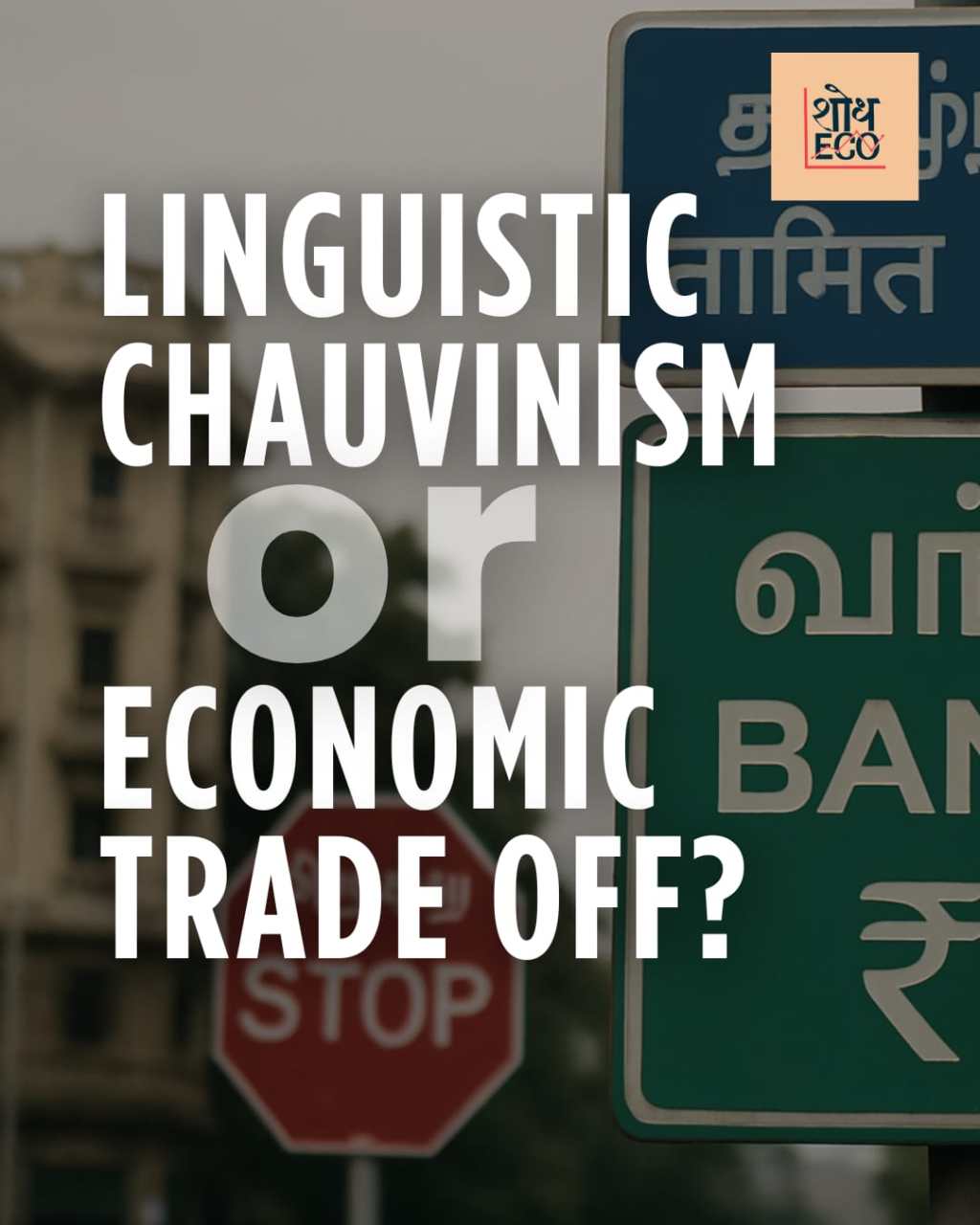

“The state of Tamil Nadu in India recently made news for its linguistic policies that oppose the usage of Hindi and facilitate the use of Tamil only in the state. it also changed the sign of Rupee to Ru pertaining to the existing feud of languages.”
What may sound as a cultural awakening movement in the southern state of Tamil Nadu has put a big question on the country’s linguistic diversity. Language is seen as a powerful tool, with economic forums advocating for multilingualism for better economic performance of a region. India is home to more than 700 indigenous languages, with its states being mainly divided by language.
Language behaves as a bridge or a barrier, depending on how it is used. Being used as a counter-mechanism against another language (Hindi), which itself is losing control over its majority speaking base, makes it a barrier for effective communication and the spread of ideas. What will happen in our scenario? The state of Tamil Nadu will push itself to become a cocoon, limiting higher education, employment, and business activities inwards and outwards. The situation may prove fatal for people who have migrated from outside, incentivising people to not come to the state; it may cause a disruption in the general idea of supply and demand of resources, money, and workforce. The situation may hint towards more reliance on English as a medium of communication. According to our honourable Finance Minister, this may lead to ‘secessionist sentiments’.
Does that mean that the promotion of the state language against the imposition of Hindi by the northern states is wrong? Maybe not. Political forces may have had their own ideas of vote share and public incentives, but the call-out by the state government and Chief Minister M.K. Stalin sheds light on the possible need for cultural identification and singularity. Policy making would give due advantage to the state-origin businesses in the state, along with scope of growth to culturally profound industries like media, literature, tourism, etc. The homegrown ideas and institutes will get a regional bonus, hence creating a market for incoming participants. Indigenous firms will probably capture the domestic market, aligning with the idea of igniting entrepreneurship and providing opportunities to small-scale firms, emphasising the MSMEs. This might also lead to more success of state-led policies and schemes, and in return can add substantially to the state revenue.
An end to the conflict is far-fetched, keeping in mind the opposing views of different political parties. However, we can look at plausible ideas to ensure better situations than the present. A possible solution is to tap into the strengths of retaining Tamil as the primary language, while also allowing for the flexibility to introduce other languages for smooth operation. The NEP could come to the rescue by implementing inclusive courses and languages in the schooling curriculum. Even history has seen that the development of the region has been positively impacted by the flow of resources and human capital, and language is a crucial part of the process.
The problems encountered with linguicism are many, from societal complexes to miscommunication and ineffective resource management. Promotion of learning in mother tongue is also necessary, but not at the cost of losing out on opportunities or skills due to not knowing enough languages. Is the outrage crucial enough to create potential disruptions in Central Government Schemes, National Education Policy, employment opportunities, and supply chains?
*Disclaimer: The opinions expressed in this article are solely those of the author. Shodheco does not endorse or take responsibility for any of the views presented.
 ShodhEco