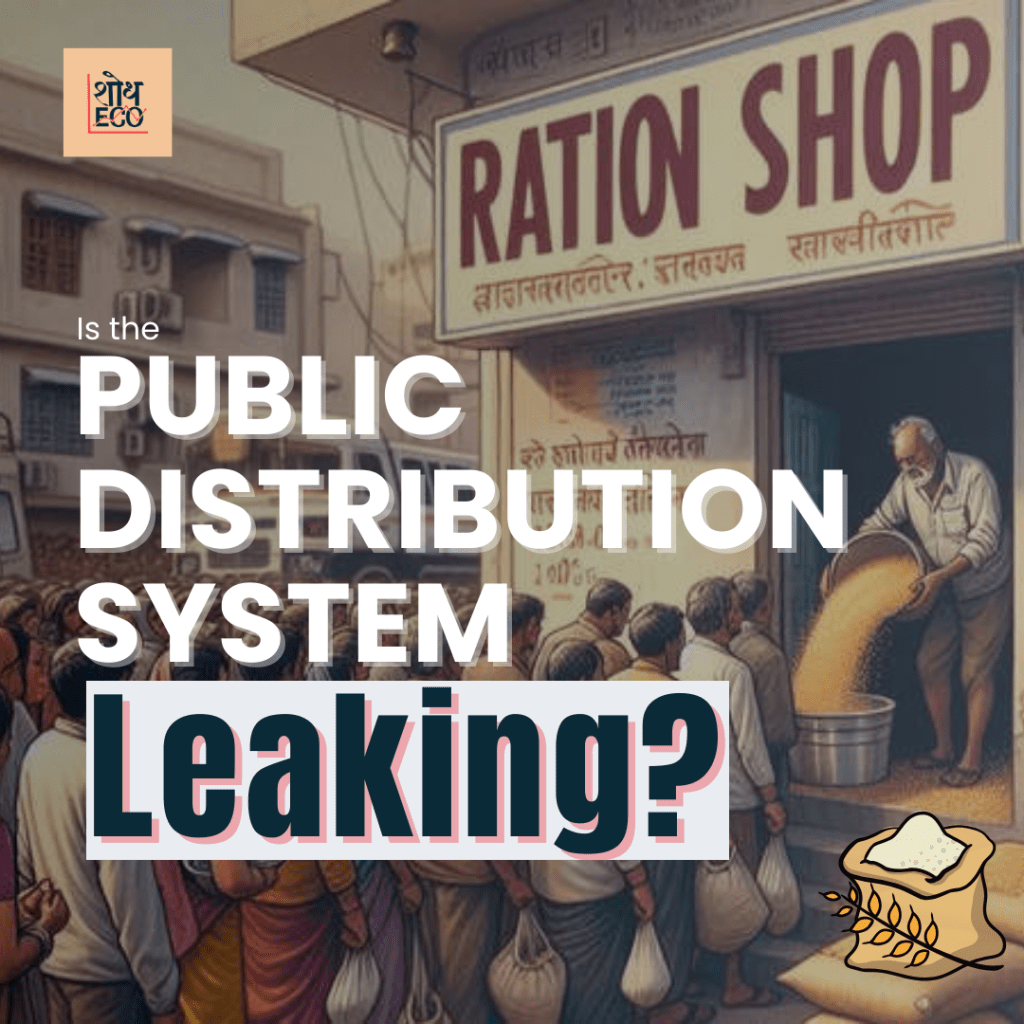

India achieved a record production of 3296.87 lakh tonnes in 2022-2023. Despite being self-sufficient in grain production,it faces persistent challenges in ensuring food security for all. Food security encompasses three critical aspects- availability, accessibility, and utilization of food. As a result, the Public Distribution System (PDS) has been a landmark public intervention for social support and food security in India. It is central to achieving this goal by providing subsidized food grains to eligible households. Although a groundbreaking policy initiative, it has been exposed to inadequacies and inefficiencies in its coverage, leading few states to adopt expanded PDS models using their own resources.
Leakages in PDS are manifested through diversion, wastage, or theft of grains before reaching the targeted beneficiaries. The leaked grains usually are diverted to the black markets or are exported for higher profits. According to the National Sample Survey (NSS) data, in 2011-12, 41.7% leakages were recorded at the all-India level. While the Household Consumption Expenditure Survey (HCES) of 2022-23 showed an improvement by PDS leakages decreasing to 22%. But still the figure is concerning. These leakages not only undermine food security but also have broader implications on food safety. The states having high leakages like Arunachal Pradesh and Nagaland are ranked poorly in the Food safety Index (2022-2023) .
The PDS is said to cover around 57% population of the country. With food security, PDS is suppose to ensure nutrition security as well. The leakages recorded of 20 MMT of rice and wheat has led exchequer costing 69,108 crores. This leads to an increase in fiscal burden on the state and also, failure to achieve PDS’s primary goals of hunger alleviation and preventing malnourishment.
Hence, these daunting statistics call for reforms in PDS to address both physical and nutritional hunger prevalent in the country. Diversification of products to include region specific staples and inclusion of perishable fruits, vegetables , at the ration shop will expand choices while addressing nutritional deficiencies and reducing leakages. As stated by Gulati and Das (2024) in their policy brief, the fair price shops need to be converted into nutrition hubs complemented with food stamp model ensuring better distribution.
Integration of direct benefit transfer into the system will enhance effectiveness. DBT to the lady of the household will empower families to make better nutritional pickings .The PDS, as being digitized across with programs like One nation, one ration is corroborating extensive coverage but leakages call for restructuring of administration and transfer of grains with minimal human intervention. The monitoring and control of the PDS can be entrusted to private entities for enhanced efficiency and effective leak proof delivery . States demonstrating minimal PDS leakages like Bihar and can act as pilot models for further policy innovations. The system’s reorganisation and realignment can be efficiently achieved by introducing blockchain technology for real time tracking and maintaining transparency through public private partnerships. PDS has been instrumental in transforming food security in India but addressing inefficiencies and ensuring accuracy in beneficiary identification is the key to realise its full potential.
 ShodhEco