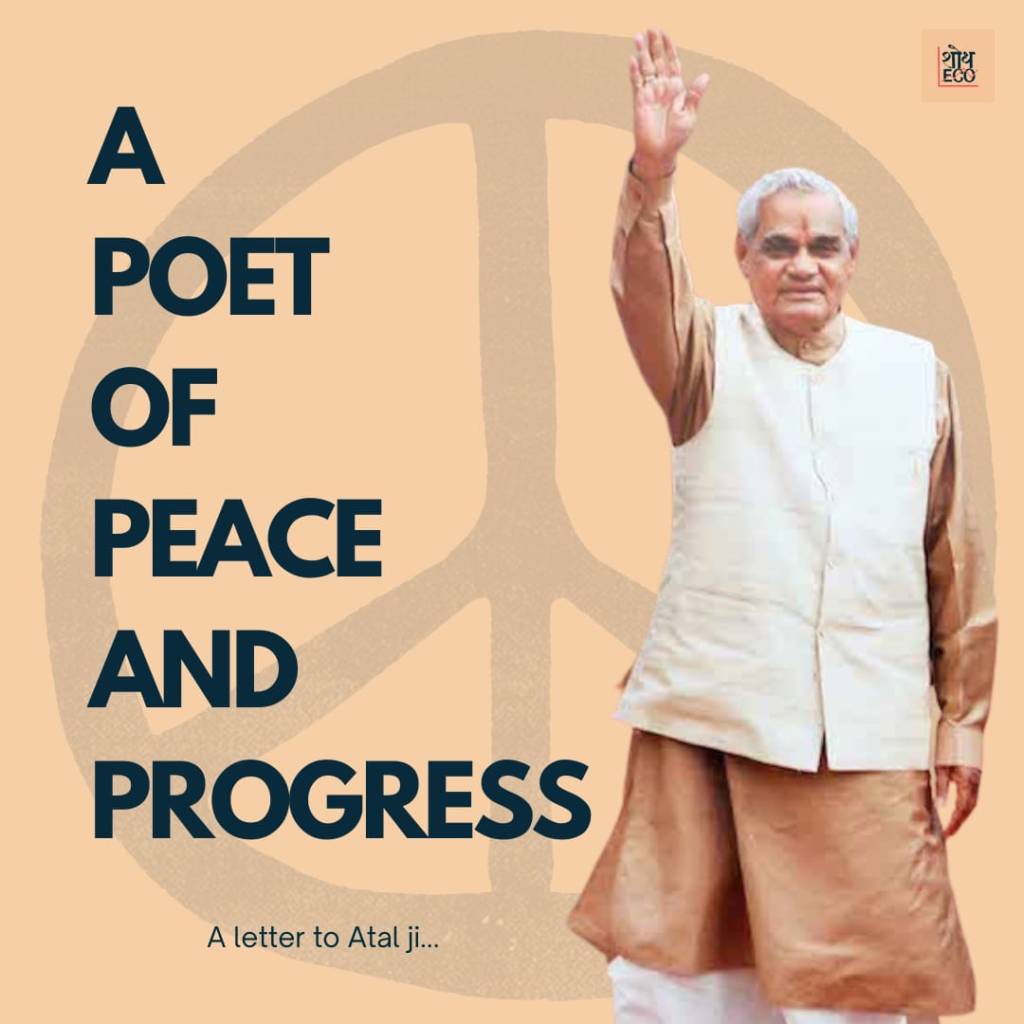

Dear Atal ji,
As I look back on your legacy that has shaped our today’s India, I find myself contemplating what truly defined your contribution to India. While many scholars, leaders regard the nuclear tests of 1998 as your crowning achievement, I very politely and respectfully find myself on the other side of the coin. Nuclear capability, while very important, brings not only power but also unnecessarily attracts insecurity of other nations. Which results in sanctions, tensions, conflicts and what not.
Your greatest contribution, I believe, lies in your vision of Peace and your extraordinary Diplomatic achievements. As Dr. Shubheendra Kulkarni, who served in your PMO, astutely observed, your role as a diplomat and statesman far outshined even your considerable achievements as Prime Minister.
You weren’t just a leader, you were a poet, a philosopher who understood the equilibrium between Power and Peace. As you once wrote:
“शांति में ही शक्ति है, पर शक्ति में भी शांति होनी चाहिए।”
(“Strength lies in peace, but peace too must be rooted in strength.”)
Your conception of India as a ‘मित्र राष्ट्र’ has served a pivotal role in setting grounds for our diplomatic relations today, particularly with Pakistan. Your moves went far beyond the conventional political moves instead they were bridges built with the mortar of trust and hope. Although the bridge was broken during the Kargil War,despite this you held for peace. Your poetic vision for peace resonated in your words:
“छोटे मन से कोई बड़ा नहीं होता और टूटे हुए मन से कोई खड़ा नहीं होता।”
(“A small mind cannot achieve greatness, and a broken spirit cannot stand tall.”)
Who forgets the historic bus journey to Lahore, it remains engraved in our memory. That moment when you crossed the Wagah border, it wasn’t just a Prime Minister traveling to another country – it was statesmanship at its finest. Your powerful words at the SAARC summit still resonate: “हम इतिहास बदल सकते हैं, पर भूगोल नहीं।”
Your understanding of the need to coexist with our neighbors led to your practical four-point formula: making the borders less significant, reducing military presence from both ends, sharing governance in Kashmir, and establishing joint oversight systems. Like once you said, when questioned by a journalist, “How will you solve the Kashmir issue?- You stood still for a while and said, “इंसानियत से”. Speaks for your different approach towards understanding Kashmir.
You were the first leader who went to China after the 1962 war. I recall your meeting with Deng Xiaoping which addressed the need for maintaining peace and stability on borders. You professed the idea of “Shelving differences and seeking joint development”, As you said:
“हमारा रिश्ता मतभेदों से नहीं, बल्कि आपसी सम्मान से बनता है।”
(“Our relationship is built not on differences, but on mutual respect.”)
In governing India, you showed us what positive secularism truly means. You were proud of your Hindu identity – “हिंदू तन-मन, हिंदू जीवन, रग-रग हिंदू मेरा परिचय” – yet you practiced ‘Raj Dharma’ without discrimination. For instance, following a defeat in the elections, the leaders of the party met in Goa in 2004 and had a discussion over the reasons behind the outcome.
When the subject of Hindutva came up, you turned to Dr. Shubheendra Kulkarni asked, “What do you mean by Hindutva?” – This displayed an understanding of Governing India which was Independent of any religion, You were a rare leader who could quote from the Bhagavad Gita while ensuring protection for all faiths. As you reminded us:
“पंथ-मजहब की दीवारें खड़ी इंसान को बांटे कैसे? मैं पूछता हूं धरती से तू बंटी कैसे?”
Moreover, The economic reforms you held a torch for, were visionary. The Golden Quadrilateral project wasn’t just about connecting cities; Essential reforms in the telecommunication sector, regarded as “The father of modern Telecom India” which laid foundations for India being one of the biggest telecom markets. Acquiring the stake in the gigantic Sakhalin-I oil and gas fields in far east Russia for USD 1.7 billion in 2001, marking India’s single largest investment abroad in those days. During your term you established the Department of Disinvestment to privatize failing public-sector organizations.
In addition, you attempted to reform the lifeline of the country, the farmers, by creating the Kisan credit card, emphasizing the need of a bottom-up development approach. It was about connecting hearts and minds. Your vision for development was captured in your words:
“आओ मिलकर बनाएं एक नया भारत जहां हर हाथ को काम मिले हर खेत को पानी मिले”
Your vision for India’s future remained steadfast as stated in these timeless lines,
“मैं जी भर जिया मैं मन से मरूं लौट कर आऊंगा कूच से क्यों डरूं?”
They served a vision that saw India, as a land of unity in diversity, strength with peace, and progress with values. Your words continue to inspire and guide us, reminding us that true leadership is about touching hearts while transforming lives. Lasty, I would like to thank you for being a man of masses, a man of nation and for nation.
 ShodhEco