
The Act
If we had to define ‘Minimum Wages Act’, it could be as simple and straight forward as An Act to provide for fixing minimum rates of wages in certain employments. The Minimum Wages Act 1948 is an act of parliament concerning Indian labour law that sets the minimum wages that must be paid to skilled and unskilled labours.
The Battle
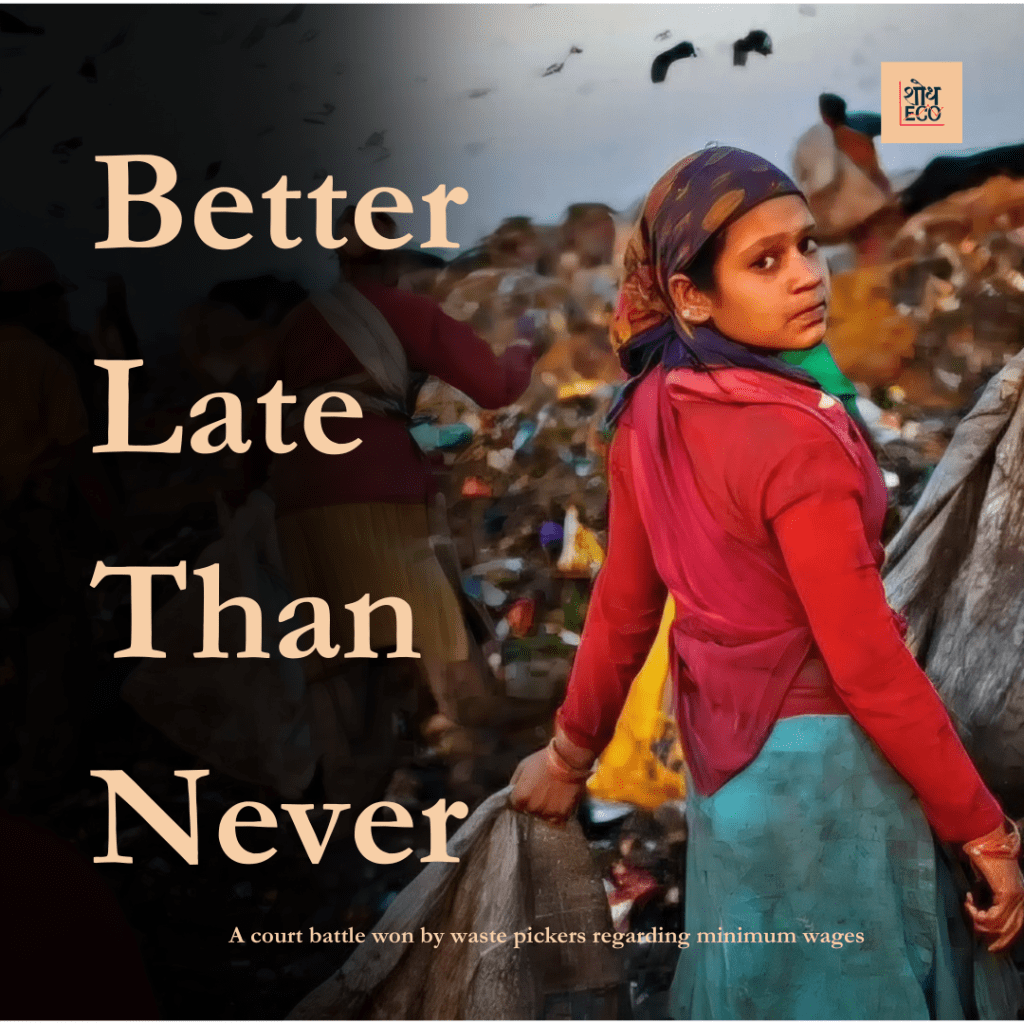
It was for the 310 women waste pickers who had to engage in a 12 year long battle to receive their minimum wages. And on 17 May 2024, the money finally hit their accounts: a whopping sum of Rs 7.5 crore in total, around Rs 3 lakh each.
The struggle of nonpayment of wages went on between December 2012 and May 2013, and then from June 2013 to June 2015.
In this period, the waste pickers had to depend upon the contractors for the payments. They were severely underpaid, receiving only Rs 3000 per month for six hours of work every day—picking, collecting, and segregating the city’s trash. They were supposed to be paid Rs 9000. When they took the matter up with the PCMC, they corrected their payment of wages and settled the matter in 2015, but two years of nonpayment had stacked up, and the contractors refused to let the rest of the money through.
This is when these strong women decided to stand for their rights of minimum wages.
It took years to form civic engagement with the municipal corporation, and even longer period of persistent follow-ups, RTIs, and staged protests to win this case. “It’s a huge victory. Unfortunately, we lost over 30 people in this process.” said, Aditya Vyas, general secretary of the waste pickers’ trade union Kagad Kach Patra Kashtakari Panchayat (KKPKP).
The way forward
There are a few proposed action items for recognising and including waste pickers:
- Policy recommendations led by The Alliance of Indian Waste-pickers (AIW).
- To identify the actual waste pickers, provide government issued identity cards and facilitate occupation based social welfare and security schemes.
- Have understanding on the renumeration.
- To prioritise integrating them within the local municipal solid waste management workstream.
- To develop local waste picker led models similar to SWACH, which would form a strong link between the waste pickers and the governing authorities.
- Take informal waste pickers to the recycling plants. Also show them the door step waste collection process. They may choose their work.
Food for thought
Let’s try to look beyond our routines and observe the surroundings. We simply push the trash bins out of our doorsteps and do not even give a thought around what happens to it ultimately! Where that is taken? Is it sold, recycled, processed or just dumped to pile up and stink!
It is time to look at this work with dignity. Let us try to visit the recycling plants, processing units with our children. Schools could arrange waste trails to develop empathetic attitude towards these processes. We would be able to better understand and acknowledge the people that are running for and around us tirelessly.
 ShodhEco