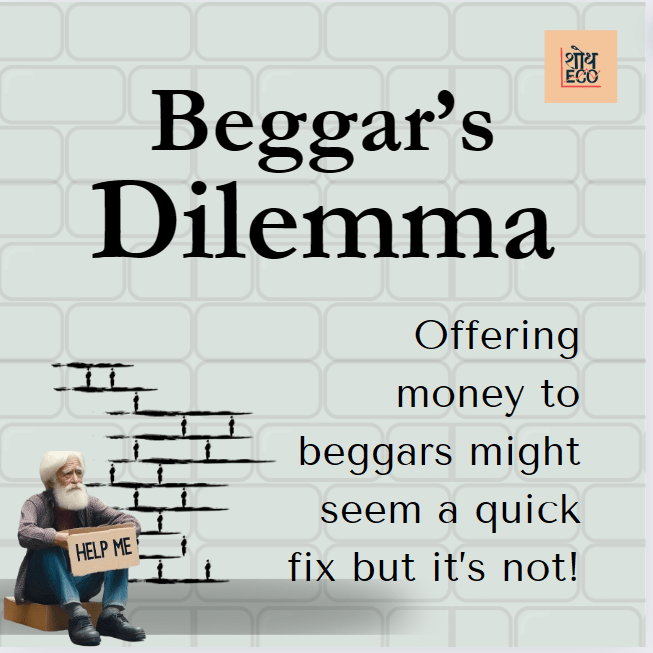

The sight of a beggar on the street triggers a mix of emotions – compassion, guilt, and sometimes even frustration. The immediate impulse to offer money is a quick fix, but we fail to see the flip side of the coin which through the article will try to shed some light on. Are we truly helping ? Or perpetuating a cycle of poverty? This echoes an age-old saying:
“Give a man a fish, and you feed him for a day. Teach a man to fish, and you feed him for a lifetime.”
While the sentiment is clear, applying this to real-world scenarios is far more challenging.
When we hand over a few rupees to a beggar, we’re providing immediate relief. This money might secure a meal, temporary shelter, or address an urgent need. At the moment, it feels like the most appropriate thing to do – a small act of kindness that could make a significant difference in someone’s day. However, this short-term solution fails to unveil a deeper problem. By providing easy access to money, although in smaller and limited amounts, we are unintentionally strengthening the practice of begging as a feasible means of survival. This leads to a type of dependency loop that is hard to break.
Like the economic concept of “moral hazard”. This leads to a perverse incentive from seeking sustainable solutions to their poverty. When people are sure that they’re going to receive help, they tend to be less motivated to look for other income opportunities. This triggers an iterating cycle of poverty trap, and they are stuck in the rut..
Many beggars find themselves trapped in a system that offers few alternatives. Without access to education, job training, or social support networks, breaking free from the cycle of poverty becomes increasingly difficult. The immediate need for survival often outweighs long-term planning, especially when there seem to be no viable pathways out of their current situation.
The dilemma here is the trade-off between short-term gains and long-term growth. Here, the trade-off is: are we satisfied giving them a meal for a day, or do we want to enable them to provide meals for themselves everyday?
As humans, we fail miserably to see the unseen.This intention of being a “positive externality” results in a “negative externality”. This shortsightedness is not limited to individual actions but extends to government initiatives as well.
Several Indian government schemes have attempted to address poverty and begging but often fall short of long-term,sustainable solutions. For example, the National Rural Employment Guarantee Act (NREGA) provides 100 days of waged employment ,the Swarna Jayanti Shahari Rozgar Yojana (SJSRY) , despite their diverse successes and failures, these schemes share a common flaw: they aim to alleviate poverty in the short term, inadvertently discouraging the poor from striving for long-term self-sufficiency and efficiency.There have been few examples where certain scheme models have performed extraordinarily well for instance: Pradhan Mantri Awas Yojana (PMAY) has accounted for providing homes to over 1,58,37,128 families from 2019-2023.
The beggar’s dilemma has no easy and ready solutions. While our instinct to help is always noble and appreciable, we must take into account wider implications of our actions. By shifting our focus from short-term relief to long-term empowerment, we can work towards breaking the cycle of poverty and begging. If we want to truly alleviate poverty in India, we need to play the long game.
 ShodhEco