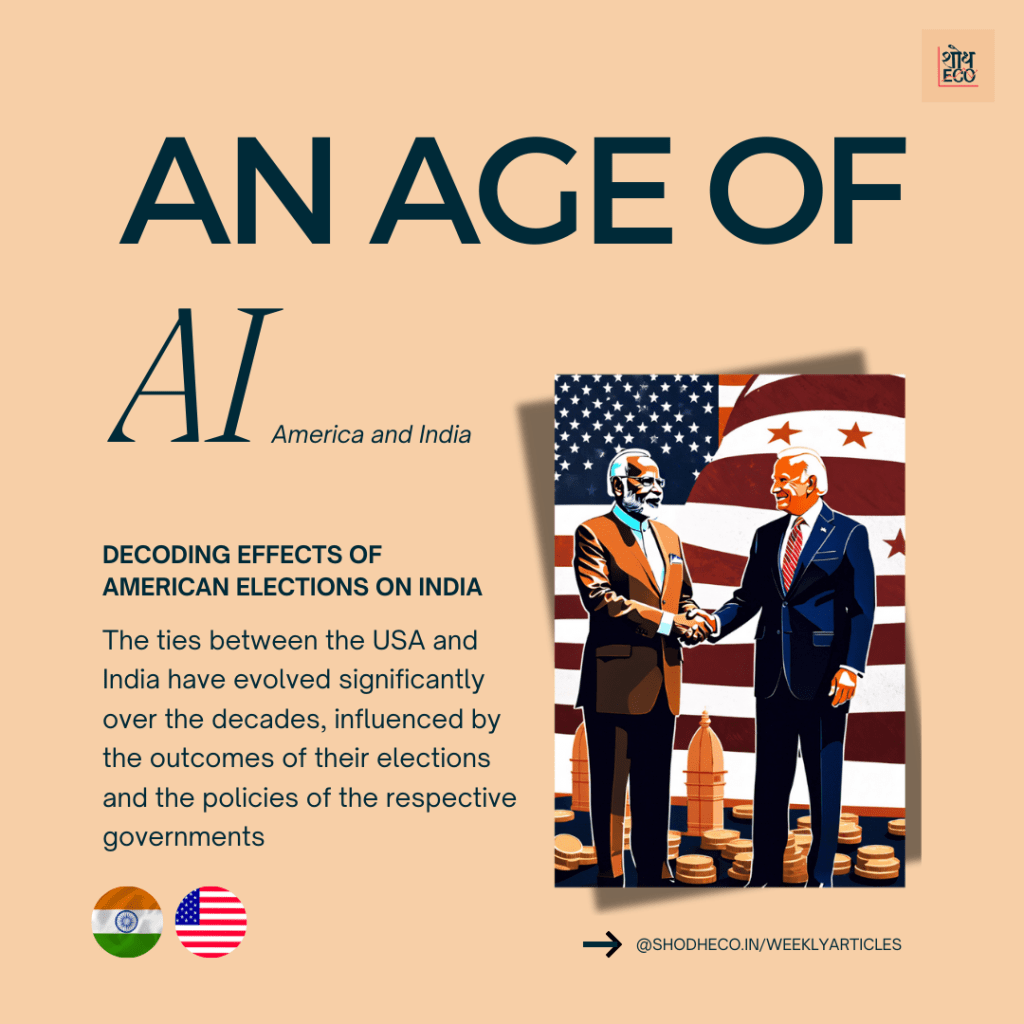

Since 1990’s, when India was under the leadership of former prime minister Shri. Narsimha Rao adapting to the unipolar structure of the world, international trade strengthened which ultimately resulted in closer ties with the United States of America. The bilateral relations between the United States of America and India are one of the most strategic and consequential relations of the 21st century. The United States appears supporting India’s emergence as a leading global power.
Historically,the vicissitudes of India and US could be deciphered with the USA’s initial support for Pakistan. But after sealing a nuclear deal, the bilateral trade between India and the USA tripled between 2004 and 2008.
The tenure of Barack Obama is considered as the golden age for India-US relations at multiple levels as the USA loud and clear started supporting India’s bid for a permanent seat in the UNSC and also, for admitting India into the Nuclear Suppliers Group and Weapons Trade group. The allegiance appears to have increased multifold due to common geopolitical interests – Indo-Pacific region, China’s easternization and this amplified after Osama bin Laden was found to be hiding in Pakistan in 2011.
But there’s more to this. Bilateral relationship between India and the United States is experiencing real time ripple effects upon each other. This has been explicitly evident since 1991. The two have been observed getting stronger irrespective of who is in power, but like always slight diversions and conversions are noticed in Indian political space after the USA elections. Hence, it all depends on the interests of the winning party that might show effects or affect Indian Politics. Let’s briefly discuss the policies and interests of the two parties which contest the US elections and also attempt to break down the effects of each on India.
Kashmir and China
Be it the Democrats or Republicans, the United States is viewed supporting Pakistan for more than five to six decades even when it involves the Kashmir issue. The United States considers that Kashmir should be a part of Pakistan and not India but on the other hand, currently it does recognize Kashmir as a part of India unlike China. And coming to China, over the years the United States has planned to develop close ties with India in order to confront China’s growing power and capacities in south and south eastern Asia.
The United States had predicted the emergence of China as a Global power and the possibility of it surpassing the USA in trade, defence and slowly attempting to replace the US as a global leader. So as of now, the United States supports India because it fears the lack of capacity building and resource competence to tackle China’s observed malignant growth. Additionally, China has been able to reap its demographic dividend and build an exceptional ability to construct or adapt to new technologies. Last year in April the US NATO Ambassador stated that, “Doors of NATO will always be open for India.” which emphasised that the United States to an extent relies on India to counter China. Linking this to Pakistan may give us a clarity of why it experienced a catastrophic economic downfall. It is reported that Pakistan was in entirety dependent on the USA’s aid and weaponry supply. But currently, the United States is showing diffused inclination in keeping up with supplying the aid frequently.
Nuclear Independence
The Democrats don’t consider India to be a stable enough country to handle nuclear armament and power. The stand of the Democrats has been visible multiple times like former president Bill Clinton-imposing sanctions on India when India secretly tested nuclear technology at Pokhran in 1998.
The Republicans appear to have no or slightly less problem with India’s Nuclear program as George W Bush signed a nuclear deal with the Indian government dated October 1st 2008 which gave India the permission to purchase or sell nuclear fuel to the United States.
Emergence of India as a Global Leader
In current times, when China appears becoming a threat to the USA and as India cultivates a more economically robust environment in its markets, the United States has been reaching out to India’s at a level playing ground and as a peaceful ally.
The Republicans supported the idea of India becoming a Global leader a little before the Democrats did. The Republicans supported India and it came as a real relief for India because whenever the democrats have assumed power the policies came with a tinge of keeping India at a bay.
Conclusion
The ties between the United States and India have evolved significantly over the decades, influenced by the outcomes of the U.S. and India elections and the policies of the respective governments . Both parties in the U.S. have gradually coincided with a view that India is an important ally in maintaining regional stability and promoting democratic values. While examining the effects of the US elections from an Indian perspective, it is quite clear that although the Democratic and Republican administrations have formulated policies in various ways, there has been a general tendency toward closer and cordial relations, albeit with subtle variations in emphasis and strategy. The direction of this strategic alliance will be influenced by the upcoming U.S. elections as well while India continues to make its place internationally. India’s changing foreign policy regime with a focus on multi-alignment definitely experiences the ripple effects of what unfolds in the USA’s political space.
 ShodhEco