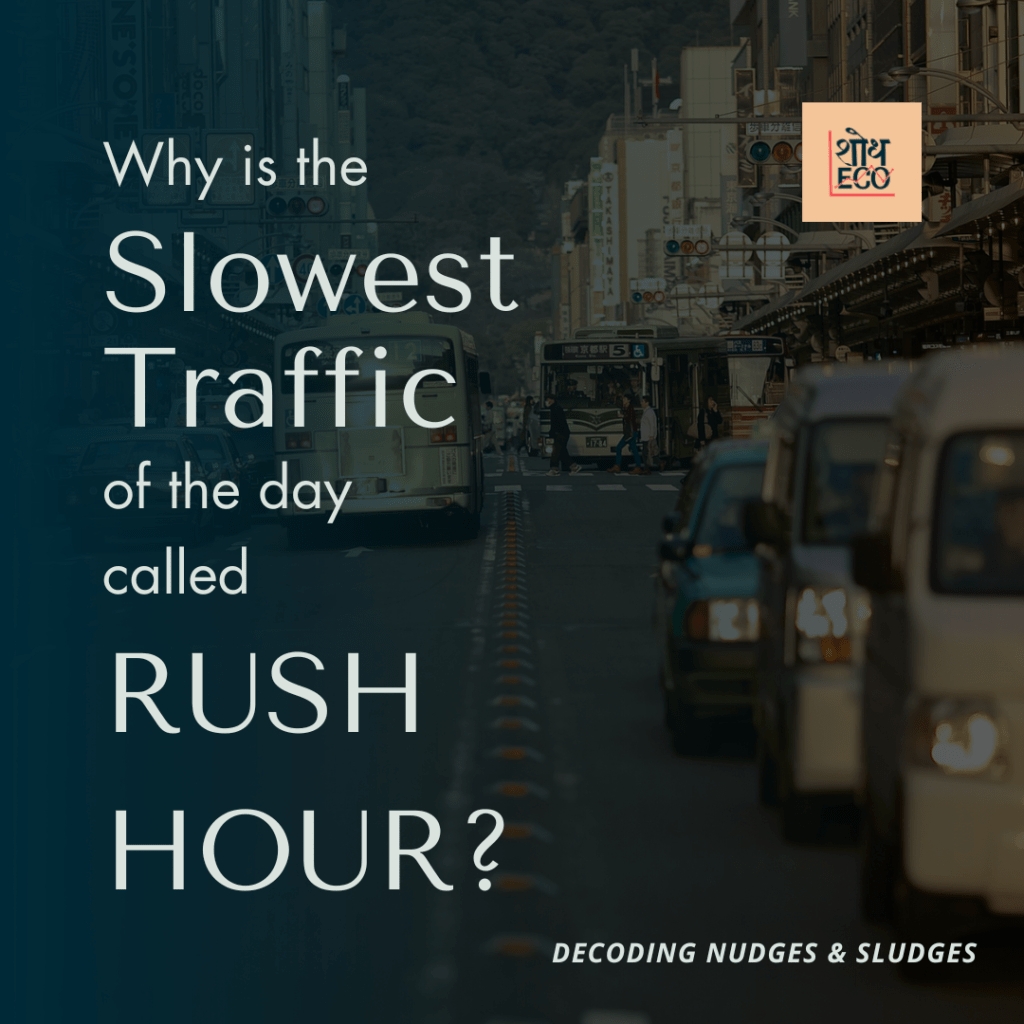

Traffic signals, which guard at every crossroads, were designed with a simple goal: to keep traffic flowing smoothly and safely. In the language of Behavioral Economics, they would title Traffic signals as “nudges” prompting drivers to stop, wait, and proceed when the path is clear. Nudges are archietectured in a way that brings in a positive change amongst the mass in a subtle fashion.
But in recent times, their signals have no say, nudges are being misinterpreted as challenges, leading to a phenomenon we can call the “early leaver” syndrome. Drivers, in an attempt to “beat the red light,” are inching forward before it’s safe to do so..Imagine you’re waiting in line at a busy temple for darshan. You see a small gap and move forward, thinking you’ll get in faster. But everyone behind you does the same, creating a chaotic crowd and slowing everything down. This is exactly what happens on the road when drivers try to jump the traffic light. What seems like a shortcut disrupts the whole system, making things slower and more frustrating for everyone.
From Nudge to Sludge
The problem with the early birds is that they upset the well-timed traffic lights. These signals are set to make as much volume flow through, in view of pedestrian lanes and carriageways. If drivers cross or enter intersections ahead of time, opposing traffic could be blocked causing the entire system to go out of sync. It is commonly observed that people who leave early actually takeoff when the countdown begins for the green lights to take over the red. This is when a Nudge becomes a “Sludge”. Increasing friction of traffic. Surprisingly we have very few wise men to stay back until the signal turns green. Which results in a chain reaction and for obvious reasons stacking up of vehicles, potentially leading to hazardous accidents and deaths.
Why do drivers engage in this seemingly illogical behavior?
- Impatience: The desire to get to their destination a few seconds earlier can cloud them up, leading drivers to take unnecessary risks.
- Competitive driving: In busy traffic conditions, there is this joy of leaving all the wheels behind, this joy is as good as winning a F1 race for some.
- Culture: Many of the times parents end-up being silly on the road, while carrying their spouse. Leading to a lineage of a culture, where not following traffic rules is just a thing. In India cities are popularized by their bad driving habits, all types of wheels( 2,3,4 ) have their own way to rule the road.
Conclusion:
Policy making is tough due to diverse stakeholder interests, nuances, and political complexities, leading to poor solutions for complex problems. For example, Singapore, driving culture is considered one of the best driving cultures, underscoring the need for culturally tailored policies. Effective policies must directly impact daily life by addressing root causes and encouraging positive behaviors, transforming societal issues from the ground up. Achieving this requires a deep understanding of local contexts and a commitment to meaningful, impactful change.
“Good policy is made when you start with a clear goal and then work backward to find the most effective path to get there.” — Michael Bloomberg.
Not to forget a better society is a byproduct of collaborative efforts of Policy designers, Implementers and we citizens holding true to our duties, and living life in a better fashion. Let’s not simply point fingers. Remember, responsible citizenship is a two-way street. While holding our government accountable remains crucial, in order to fulfill our civic duties while adhering to the rules and regulations implemented by them is equally important. Together, let’s move beyond critique and work towards a more collaborative and effective future.
 ShodhEco