Author: Vaidehi Kedia
The number of independent candidates winning in Lok Sabha elections have reduced significantly since Independence. The number of independent MP’s who were at 36 in first Lok Sabha in 1952 has come down to 4 in the outgoing House. According to Election Commission of India, more than 99% of Independent candidates have lost their deposits in Indian elections since 1991 which shows a decline in voter’s trust in independent candidates over the years.
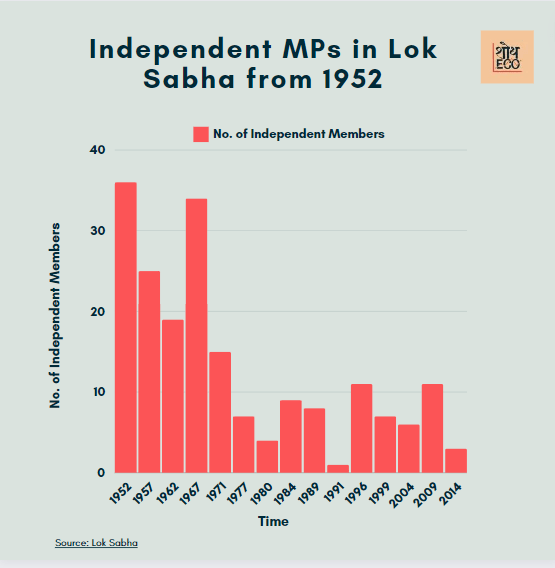
More than 15 independent members were elected till first five Lok Sabha elections which is about 68% of total independent MPs. But , the post-Emergency Lok Sabha in 1977 had only seven of independent members and the number went down to 4 in 1980. More shockingly, in 1991 , the House had only 1 independent member. In 2019, 4 of independent candidate made it to Lok Sabha.
Who are independent candidates and why their numbers are falling?
An independent candidate in elections within a democratic economy is someone who runs for office without affiliation to any political party. Independent candidates typically rely on their own platform, beliefs, and support base rather than the backing of a political party.
So the problem lies in the nature of such candidates itself. These candidates have some restrictions which political parties do not, like limited resources where in candidates lacks the financial and organizational support available to major party candidates, making it difficult to run a competitive campaign. They also don’t have any name recognition or party support without which they often struggle to gain visibility and credibility among voters. Credibility forms voters perception wherein voters may perceive independent candidates as less viable or effective in bringing about change compared to candidates affiliated with established political parties.
Is participation of independent candidate good for the economy ?
The impact of independent candidates on the economy can vary depending on various factors such as their policy proposals, expertise, and ability to work within existing political structures. Independents may bring fresh perspectives and ideas to economic issues, potentially fostering innovation and addressing neglected issues. Some of the benefits which economy can have is:
Policy Innovation: Independent candidates often bring fresh perspectives and innovative policy ideas to the table. They may propose solutions that the mainstream parties haven’t considered, which could lead to more effective economic policies.
Accountability: Independents are not bound by the agenda of a political party, so they may be more accountable to their constituents rather than party leaders or special interests. This could lead to better representation of the economic interests of their constituents and less influence from vested interests.
Increased representation and encouraging Diversity: Supporting independent candidates can encourage diversity of thought and representation within the political system, fostering greater inclusivity and responsiveness to the needs of all citizens.
Encouraging Debate: By challenging the status quo and offering alternative viewpoints, independent candidates can stimulate public debate on economic issues. This can lead to greater awareness and understanding of economic challenges and potential solutions among the electorate.
Regional Development: Independent candidates who focus on regional issues can play a role in promoting balanced regional development. By advocating for investment in infrastructure, education, and healthcare in underserved regions, they can contribute to reducing regional disparities and promoting inclusive economic growth.
However, their influence and the extent of these benefits might be limited by the constraints they pose. And while independent candidates may face challenges in terms of funding and campaign infrastructure, their presence in the political landscape can enrich the democratic process and potentially lead to positive outcomes for the economy.
 ShodhEco
One response to “No win for Independent candidates! ”
Independents backed by a political party is the new trend.*to support/oppose defectors
And even if Independent MPs introduce any legislation, how are they going to get it passed ???
Also it’s not like people are losing the trust in Independent MPS ,people vote for candidates from an established party so there won’t be any issues in devolution of fund.‘ Double Engine ki Sarkar’ = progress, is a perception which is also true to an extent. (I’ll even say Triple Engine is needed as PRIs get 70% of funds from the Union govt)
LikeLike