
Author: Harshada Abhyankar and Rushikesh Mule
With the 2024 elections around the corner, the national and state political parties are putting forth successively, the list of candidates who would be contesting for 550 seats in the 18th Loksabha. Elections regarded as a festival of democracy, need to be analyzed in depth as far as achieving gender equity and parity in legislature and leadership of the country is concerned.
Let’s delve into current candidates listing declared by various political parties for 2024. Till now, 7 lists have been put out in the public. Insofar the current ruling party has declared contestants for 509 constituencies out of which only 73 are female candidates. Indian National Congress has fielded 212 candidates till now with only 25 females making it to the list. The picture of State parties exhibits no distinct picture. The candidates fielded by All India Trinamool congress in the state of West Bengal are 42 out of which 12 are females.
Reading through the statistics of past years Lok-Sabhas, we observe the increasing women participation as members of parliament and also as voters. The following graph published by PRS exhibits the fluctuations observed through 17 Lok-Sabhas in women participation.
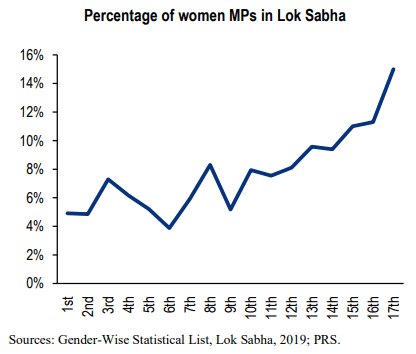
The 1st Lok-Sabha saw around 5% women participation as MPs and the latest one had around 15% women participation in the sabha. But the rise observed is not consistent. Though the constitution with its adoption in 1949 granted universal adult franchise, the provision does not appear to have been significantly reflected through years in the legislature. The choices available for women voters or voters in general are male centric to a significant degree. Hence, it may be surmised that elected Loksabhas have been male dominated due to lack of evenness and richness of choices available to a voter.Not always will women elect women or some men elect women but widening of choices would grant the freedom to twice assess the choices being made. If the EVMs look equally distributed among genders, adopting this as a mechanism of choice structuring would help to increase the number of women in leadership.
Through documented literature, to an extent it appears that default preference of parties have been listing a male candidate and females are demonstrated as an step towards inclusivity and gender parity. The listing of males or females need to be structured on their work contribution, affinity with the constituency and appeal of the voters.The identification of females to purposefully restore equity need not be an exercise but a natural act of choice making without bias.
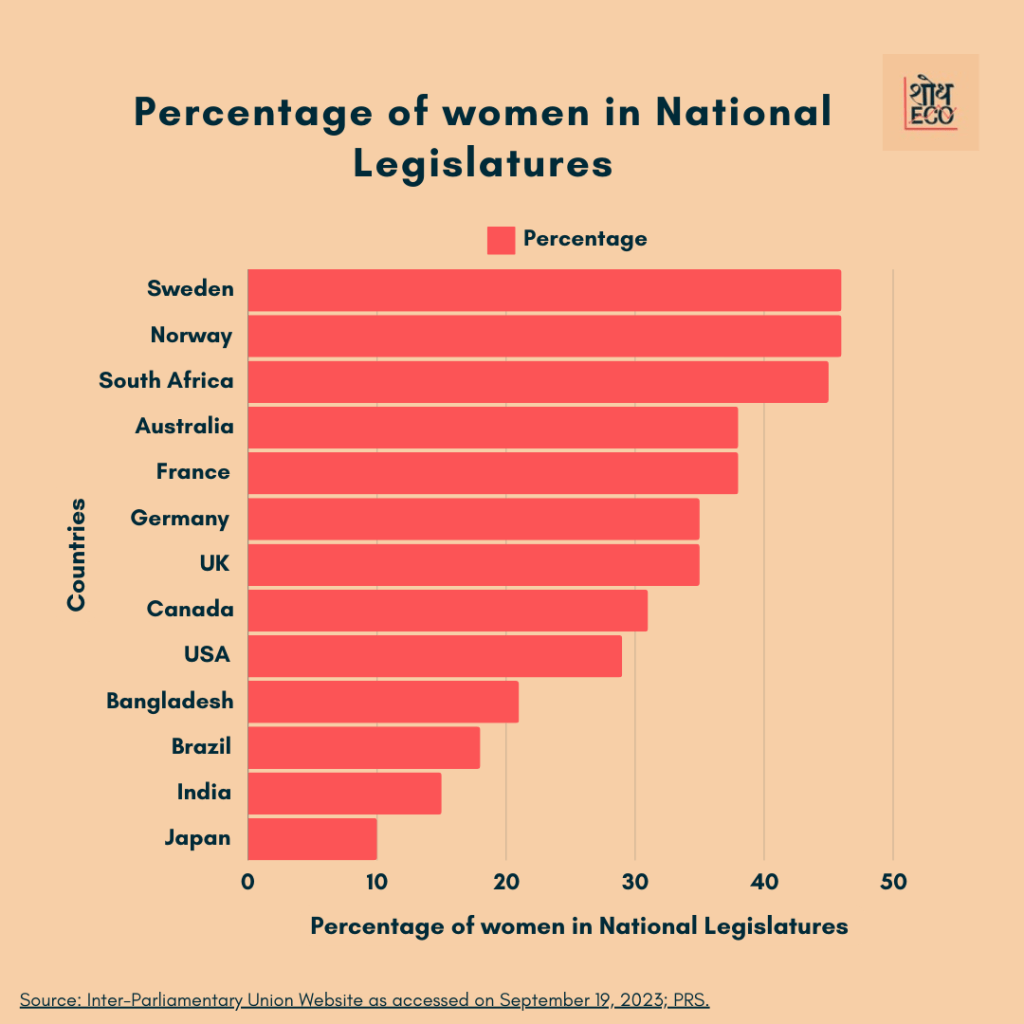
India hovers at 15% female representation in leadership and legislature. The Nordic countries have been able to achieve gender parity to an extent with representation as high as 46% in Sweden and Norway. Though we form the world’s largest democracy, as a developed and evolved democracy we need to include women an later representatives of LGBTQ+ community as well.
Looking through states of India, the trend observed in women candidates is not uniformed but driven by perceptions about femininity, women hold over politics, beliefs about leadership and its relation with women. The 17th Lok Sabha elected 78 female candidates, including 12 from Uttar Pradesh (UP), 11 from West Bengal, and 8 from Maharashtra, accounting for 14.44%. There are several causes contributing to low representation of women in the Lok Sabha. Firstly, men are observed not to vote for women. According to research conducted by M. Kapoor et al. at Brookings, women are more likely to run for office in areas where the gender ratio is skewed against them, like Uttar Pradesh and Bihar, making them a minority. Secondly, political parties often have little incentives to nominate women. Many studies point to the absence of co-gender voting in India as a contributing factor. Along the same lines, there are numerous factors that cloud the Indian election scenario. Factors such as a candidate’s religion and caste identity, in-group favoritism, party identification, and prejudices against female politicians all play a vital role in elections.
The facts rendered above about the forthcoming Lok Sabha Elections 2024 indicate the a similar trend where women account for not more than 14% of major party candidates fielded for the general elections. So if the major parties don’t offer tickets to women, then contesting independently remains as an option, but that brings along another set of hurdles to be discussed and debated sometime later. A profoundly evolved democracy needs women as well as men because democracy is about the consensus of the society and women make up half of the society.
 ShodhEco