Author: Ansh Arora
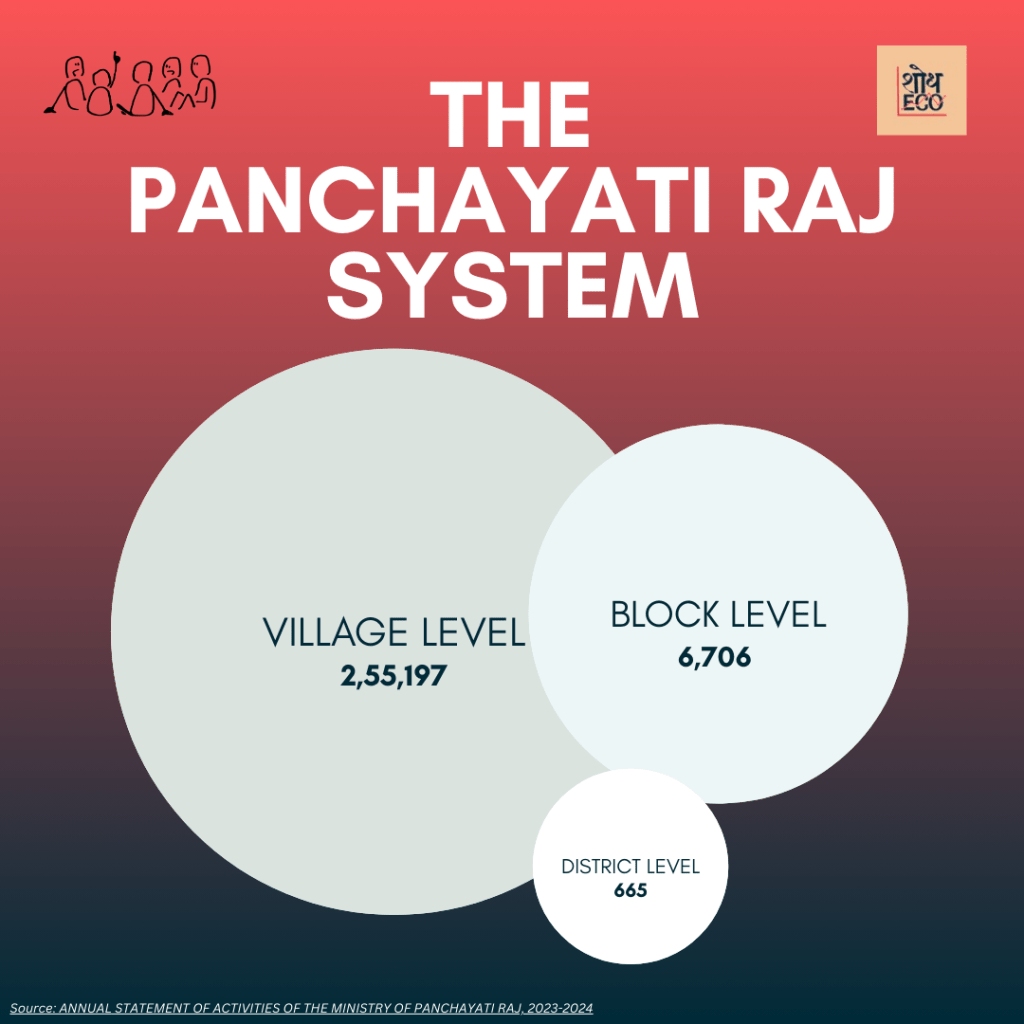
Mahatma Gandhi famously said “The future of India lies in its villages” Following the same ideal of ‘Gram Swaraj’, P V Narsima Rao government passed the 73rd and 74th Constitutional Amendments, following the recommendation of LM Singhvi Committee, constitutionalising three-tier system of local governance in India, with Panchayati Raj Institutions (PRIs) at the village, block, and district levels. This step was taken to penetrate the grass root levels with democratic decentralization in order to promote inclusive development. PRIs are bodies of local self governance.
The smooth sailing of PRIs is highly dependent on the state’s initiative for its development. All states have implemented reservation for women, Scheduled Castes (SCs) and Scheduled Tribes (STs) bringing almost 1.6 million representatives from these groups into elected positions in the Panchayats, making the Panchayats the nursery of future leadership. According to Ministry of Panchayati Raj(MoPR) of the total representatives over 50% were women, 12% SCs and 9% STs and OBCs in 2009.
But one has to also look deeper than what is stated on paper to ascertain how much of it is truly benefiting the cause of social inclusion.
State Finance Commissions (SFCs) have been constituted and in many States, for devolution of funds to the local bodies. District Planning Committees have also been set up to initiate decentralized planning processes.
However, implementation of these constitutional provisions, which were left to the discretion of the states, varies greatly, hence impacting the functioning of the local government bodies.
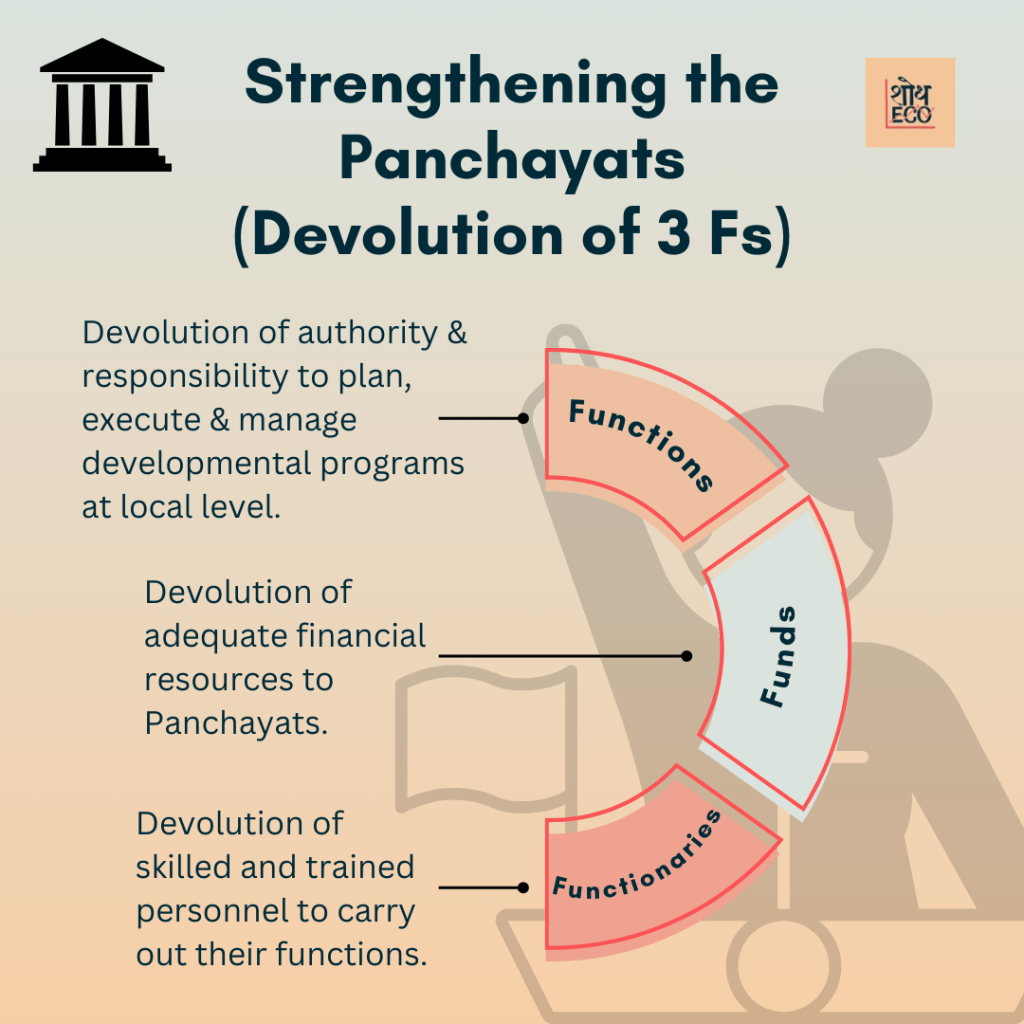
The most important aspect seen in strengthening the Panchayats is the devolution of 3Fs (Functions, Funds and Functionaries), of which devolution of funds to match the functions and funds is key for successful decentralization that promotes growth in the economy.
Another is their enablement for preparing and implementing bottom-up participatory plans for economic development and social justice. It is important to note that while some states are ahead in implementing new ideas through trial and error, others still have to catch up.
The Backward Region Grant Fund (BRGF) is a Programme implemented by the Ministry of Panchayati Raj (MoPR) in 272 identified backward districts in all States of the country except Goa to reduce regional imbalances in development. BRGF consists of Development Grant and Capacity Building Grant to the panchayats.
The Panchayat Empowerment and Accountability Incentive Scheme (PEAIS) which aims at encouraging states to adequately empower the Panchayats for bringing efficiency, transparency and accountability in the Panchayats, has been put in place for incentivising the states to put efforts. Their performance is measured through a Devolution Index (DI). It is to compare the status of transfer of power and resources in various states in decentralizing of powers and resources and empowering of panchayat raj, covering the transfer of functions, institutions, functionaries, and finances to PRIs. It also analyzes the process of budgeting in various local governments and records the status of functioning of the State Election Commissions, State Finance Commissions and mechanisms in place for District Planning.
The DI of 2015-16 by the Ministry of Panchayati Raj states that Kerala, Maharashtra, Gujarat, Sikkim and West Bengal were among top performers in the devolution done in practice. While Bihar, Jharkhand, Uttar Pradesh and Rajasthan were among poor performers.
Even with the constitutional backing and provisions being made, the Panchayats are not delivering the desired results.
- The main reason for this is the lack of adequate devolution together with tied nature of funds.
- Moreover, since the Panchayats have limited sources of revenue which causes overwhelming dependency on government funding.
- They also don’t fully capitalize on their fiscal powers arguing that they can’t levy tax on the constituency you live in.
The 14th Finance Commission had provisions of devolution of funds to Panchayats for spending on local plans concerning developmental issues like sanitation, drinking water, maintenance of community assets, etc. However, the same provisions were not included in the report by the 15th Finance Commission. SFCs are severely lacking when it comes to making a comprehensive budget allocation for the local government bodies.
Therefore there is an imperative need for an effective fiscal decentralization in order to ensure that the finances available with the Panchayats match the transferred functions based on activity mapping for the devolution of 3Fs for them to meet their expenditure needs that will take them on the path of development.
It is high time that the benefits of ever-increasing public spending, through a plethora of schemes reach people for whom they are directed in a good measure. We have a long road to traverse with planning for local economic development and social justice still being a distant dream for all states.
 ShodhEco