Author: Shruti Sane
Trade is defined as a voluntary exchange of commodities and services between a wide range of economic actors like consumers, firms, and even countries. Since there is no obligation to trade, a trade will only occur if it individually benefits the interests of all the parties involved.
Diving into the technical grounds, trade tends to have a specific meaning depending upon the context. In the context of international trade, trade is defined as either the export of goods and services that a country can efficiently produce or the import of goods and services for which a country lacks resources.
In recent times, the dynamic and evolving global markets have given rise to several trade regulations and policies to ensure fair trade practices.
India has an ancient history of trade, with its roots going back to 600 BC, involving the export of spices, metals, and textiles. Post-independence, India being a closed economy did not focus on trade activities as the primary focus was localization and promotion of domestically produced goods and services, along with importing a few necessities like crude oil. It was only after the reforms of 1991 that India became an open economy. This led to the introduction of the Export-Import Policy (EXIM) which is now known as the Foreign Trade Policy (FTP).
After the FTP 2015 ended in 2020, the government was supposed to announce the new foreign trade policy for the next 5 years but due to the COVID-19 pandemic, the government decided to continue the same policy for the next few years with some amendments and modifications. It was only in 2023 when the foreign trade policy was introduced. Announced by Minister of Commerce, Shri Piyush Goyal on 1st April 2023, the new foreign trade policy aimed at integrating India into global value chains and establishing India as an export hub, reducing import dependencies.
Some of the important features of FTP-2023 are:
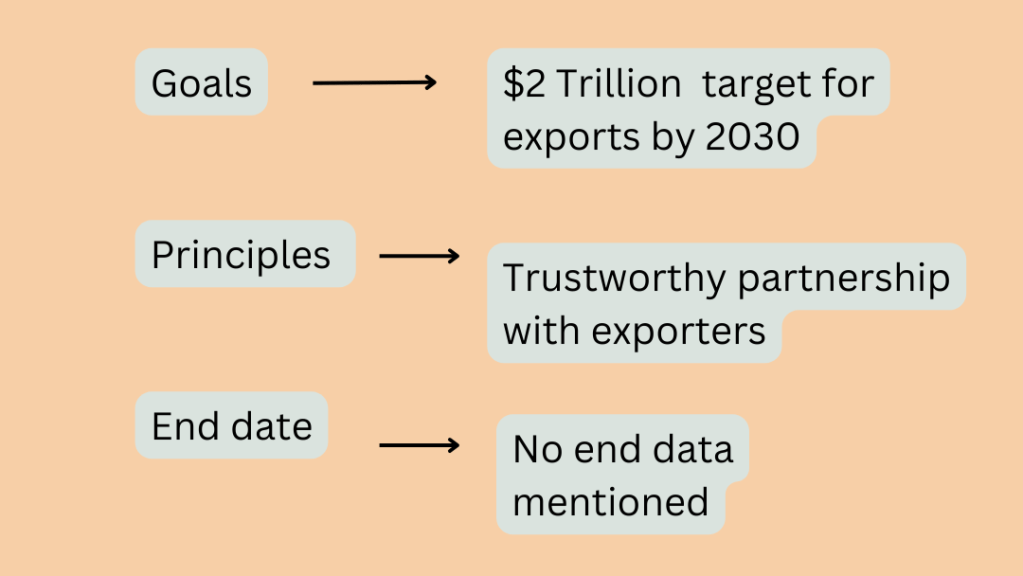
- The government targets the export of goods and services to $2 trillion by 2030.
- Unlike earlier FTPs, there is no “sunset provision” for the current policy. Sunset provision here means that there is no due date or withdrawal time for this particular policy The advantage of this feature aids in the avoidance of confusion among exporters regarding the continuation or discontinuation of various incentive schemes. While this decision might save time and costs associated with the formulation of a new policy, the dynamic business environment demands a constantly evolving policy.
- The Indian government is taking care of the aforementioned problem by introducing amendments and modifications periodically in the current schemes to adapt to the changing environment. The government has also mentioned that the policy can also be changed, if required, based on the consultation with the stakeholders.
- The government also intends to encourage the use of the Indian Rupee in cross-border trade.
Key pillars of FTP2023
Incentive to Remission
Export promotion through collaboration
Ease of doing business
Emerging areas
Spotlight on FTP2023
- Trade facilitation & ease of doing business
- A Directorate General of Foreign Trade (DGFT) will function as a facilitator of exports and imports.
- To reduce transactions and handling costs, a single windows system to facilitate the export of perishable agricultural produce is being introduced through APEDA
- Niryat Bandhu scheme: As a hand-holding scheme for new export-import entrepreneurs, DGFT is implementing the Niryat Bandhu scheme for mentoring new and potential exporters on the expansion of foreign trade.
- Online facility for e-certificate of origin (E-COO): DGFT has created a common digital platform for the issue of preferential and non-preferential certificates of origin by agencies.
- Government Incentives: The Government of India has implemented various export promotion incentives to boost trade and exports. These incentives include schemes like:
- Merchandise Exports from India Scheme (MEIS)
- Export Promotion Capital Goods (EPCG) scheme
- Export Oriented Unit (EOU) scheme
A roadmap towards $2 Trillion exports-
Starting from 2021-22, the export value must grow at 13.235% per annum. However, due to the mismatch & depreciation of currency between savings & investment, the actual volume of exports should grow between 17.53% &19.70%per annum. Though adequate incentives and programs are in place to enhance India’s exports, to meet this aim, the goods & services sector must grow at 10.86% & 17.15% per annum respectively. This implies that the weighted growth of total exports must be 13.23% per annum from its 2021 level.
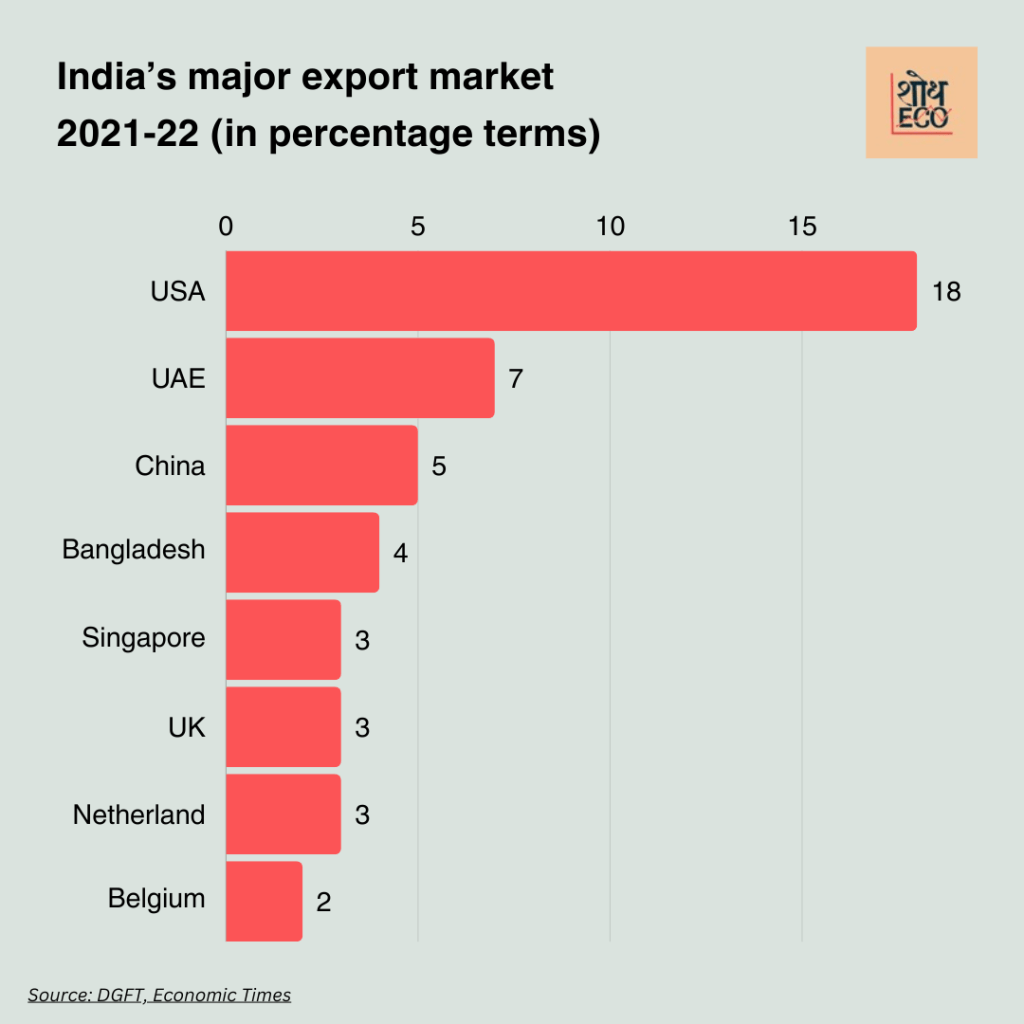
The above chart shows the countries demanding Indian exports in 2021-22, with the USA being the top demanding 18% of India’s total exports. Similarly, India’s total value of exports increased. The value increased to $760 Billion in 2022-23 from $676 Billion in 2021-22.
As the saying goes “There are two sides to every coin”, the Foreign Trade Policy of 2023 has received some fair share of criticism from the experts despite its optimistic goals. In my opinion, the FTP 2023 lays heavy emphasis on promoting exports but says nothing about managing imports. To narrow down the current account deficit, it is important to reduce the dependency on imports. Tackling imports is also important from the perspective that excessive imports negatively impact the domestic industry and discourage domestic producers as they face competition from foreign producers. The 2nd major challenge that FTP 2023 is facing is a domestic one, in the form of regional imbalance. The FTP 2023 mainly benefited the cities as it strengthened the business hubs whereas it completely neglected the rural areas, widening the already existing income inequality.
FTP 2023 comes as a significant policy framework aligning goals of globalization but steadfast localization. It contributes to the growth of indigenous industries and the integration of the Indian economy with global markets. The government must constantly monitor the progress of the policy and make amendments accordingly, especially addressing the regional disparities and dependencies on imports To emerge as the voice of the South, India needs to emerge as a trade leader as well. Soft and hard power diplomacy will be robust if trade capacities are enhanced and contribute to the global economy. Because those who have ruled the trade routes have ruled the world.
 ShodhEco