Author: Rushikesh Mule
As a student of economics, I am well aware with terms like consumption expenditure, propensity to consume, consumption basket etc.,. They may seem bit technical at the first glance but they are not! In fact they play an important role in our life. However, apart from bookish definitions of these concepts, sometimes I wonder what an average Indian consumes? What food items are a part of his/her plate? How much money he/she actually spends on food items? and are there any non-food items that Indians spend their money on? Of course each of these questions have different answers and that is what I am trying to understand through this article.
Okay, so we need to start with facts for which we need data! and although the population related date is recorded by several institutions in India, the institution that is at the forefront of this task is the National Sample Survey Office (NSSO) under the Ministry of Statistics & Program Implementation (MOSPI). NSSO conducts a survey called The Household Consumption Expenditure Survey (HCES) which collects information about the consumption of goods and services by households in India. This survey will help us in understanding the consumption & expenditure pattern, standard of living and well-being of Indian households. Luckily, for the first time in 11 years, NSSO released broad findings of consumption expenditure of Indian households. They conducted this survey between August 2022 and July 2023
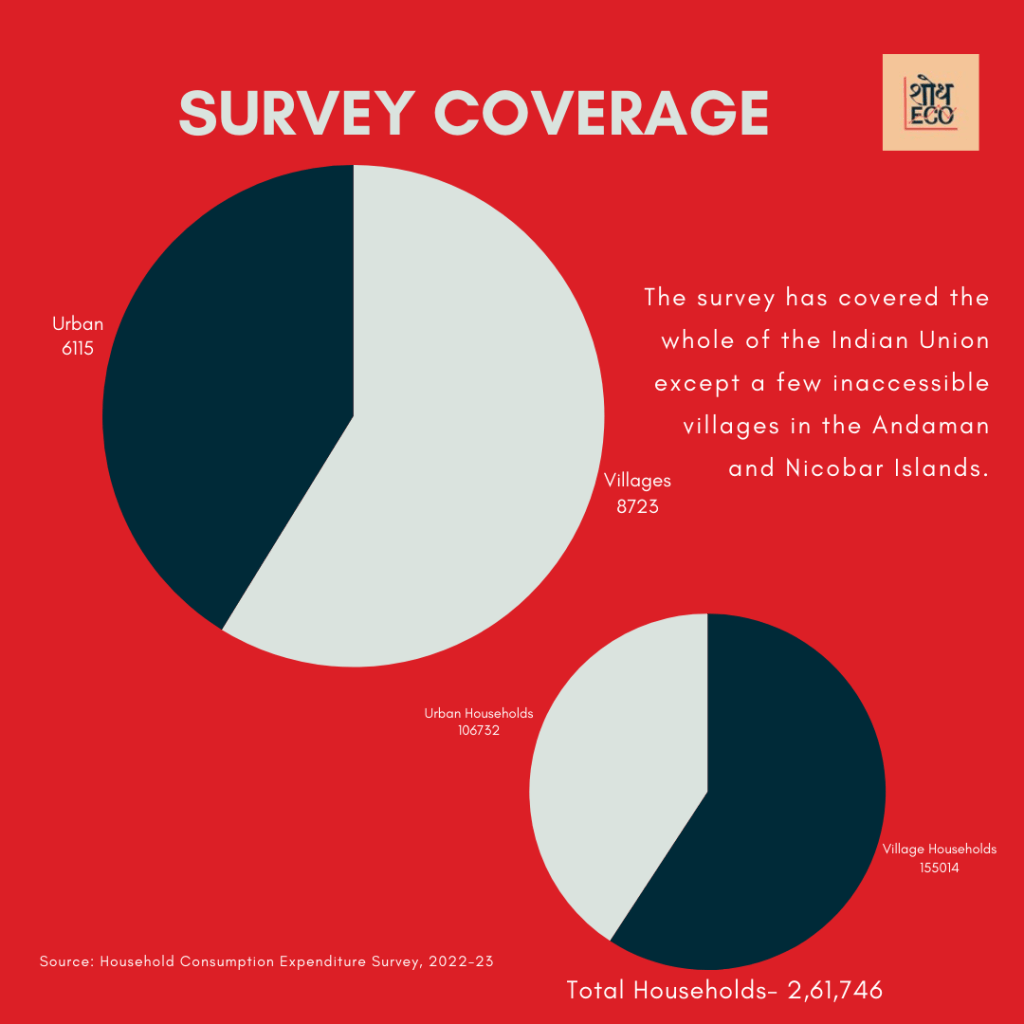
NSSO presents its data in the form of Monthly Per Capita Consumption Expenditure (MPCE). Now what does that mean? As defined by NSSO itself, it means the household consumer expenditure over a period of 30 days divided by the household size. It is important to understand that this survey collects data of consumption expenditure of entire household and then divides it by the size of respective household unlike in USA the Bureau of Economic Analysis (BEA) state per capita personal consumption expenditure statistics are calculated by dividing personal consumption expenditures with population.
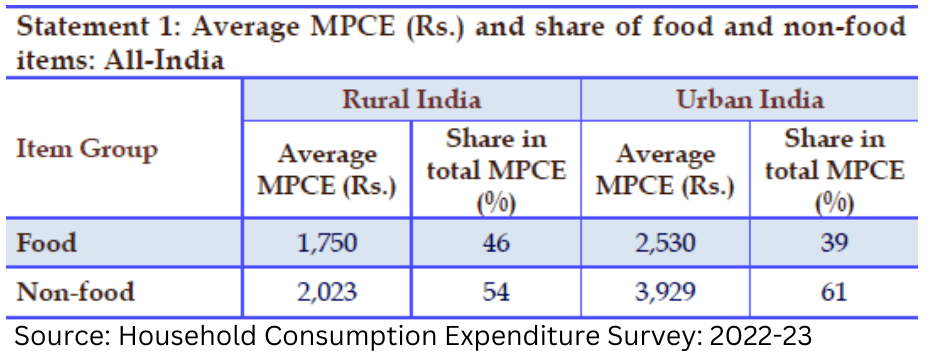
According to the above table/graph rural India spends on an average 1750 Rs on food and 2023 Rs on non-food Items. Similarly, Urban India spends 2530 Rs on food and 3929 Rs on non-food items.
Now I have a question here, why is there such a striking difference between consumption expenditure in Urban and Rural India? One reason can be the cost of living, according to cost of living index in India 2023, tier 1 cities have significantly higher cost of living (27.7 to 26.9 points) as compared to tier 2 and tier 3 cities. Along with that rural Indian remains relatively more equal in terms of consumption levels, albeit at lower overall expenditure (Balasubramanian et al., 2022). Along with these there can be several other reasons such as income gaps, changing priorities etc.,.
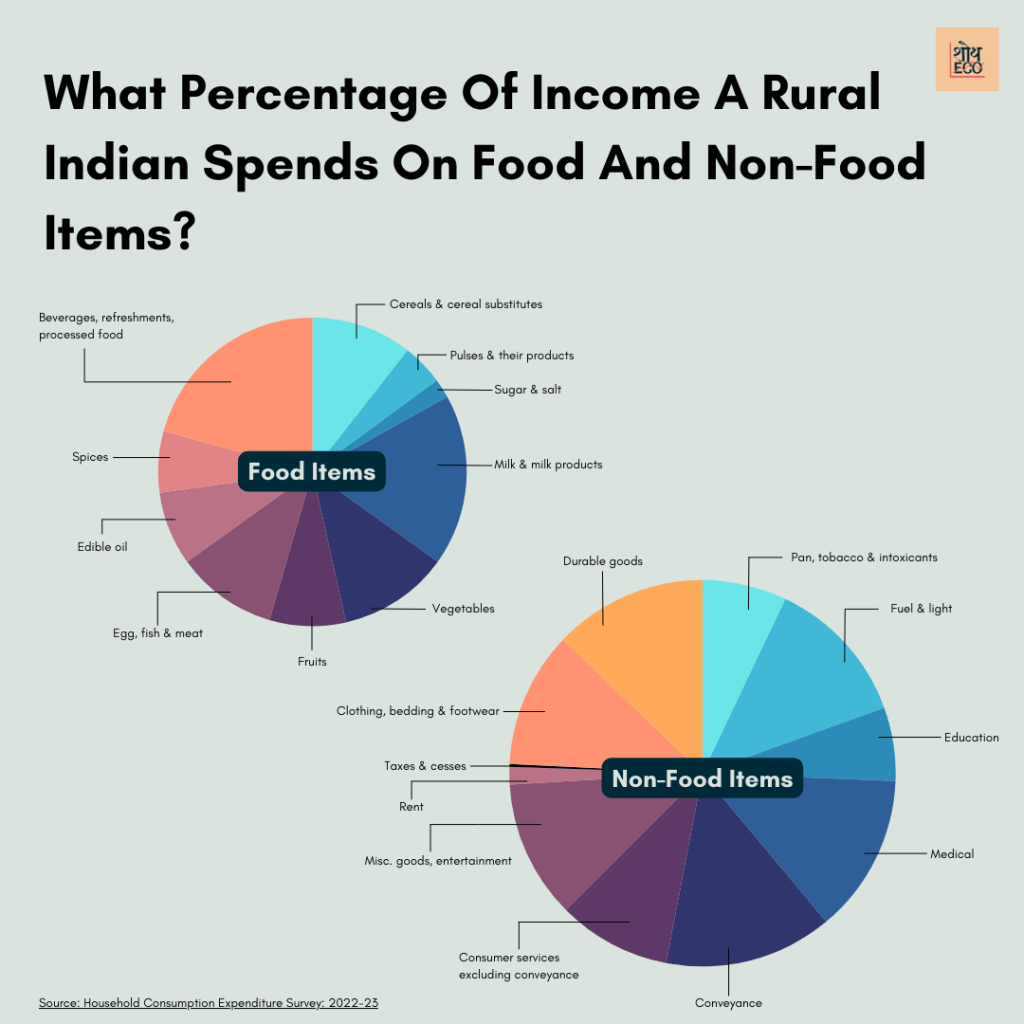
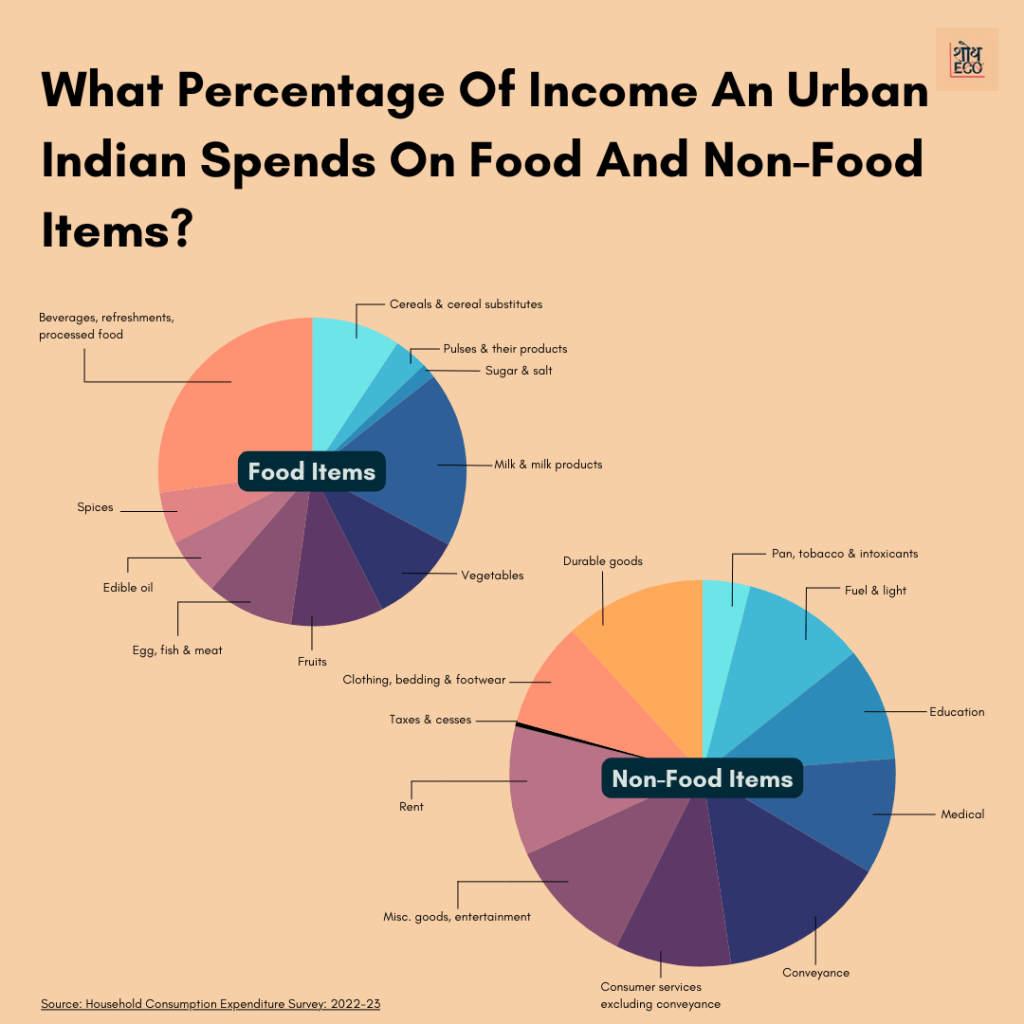
Above infographs give us idea about what goods & services an average Indian spends his/her money on!
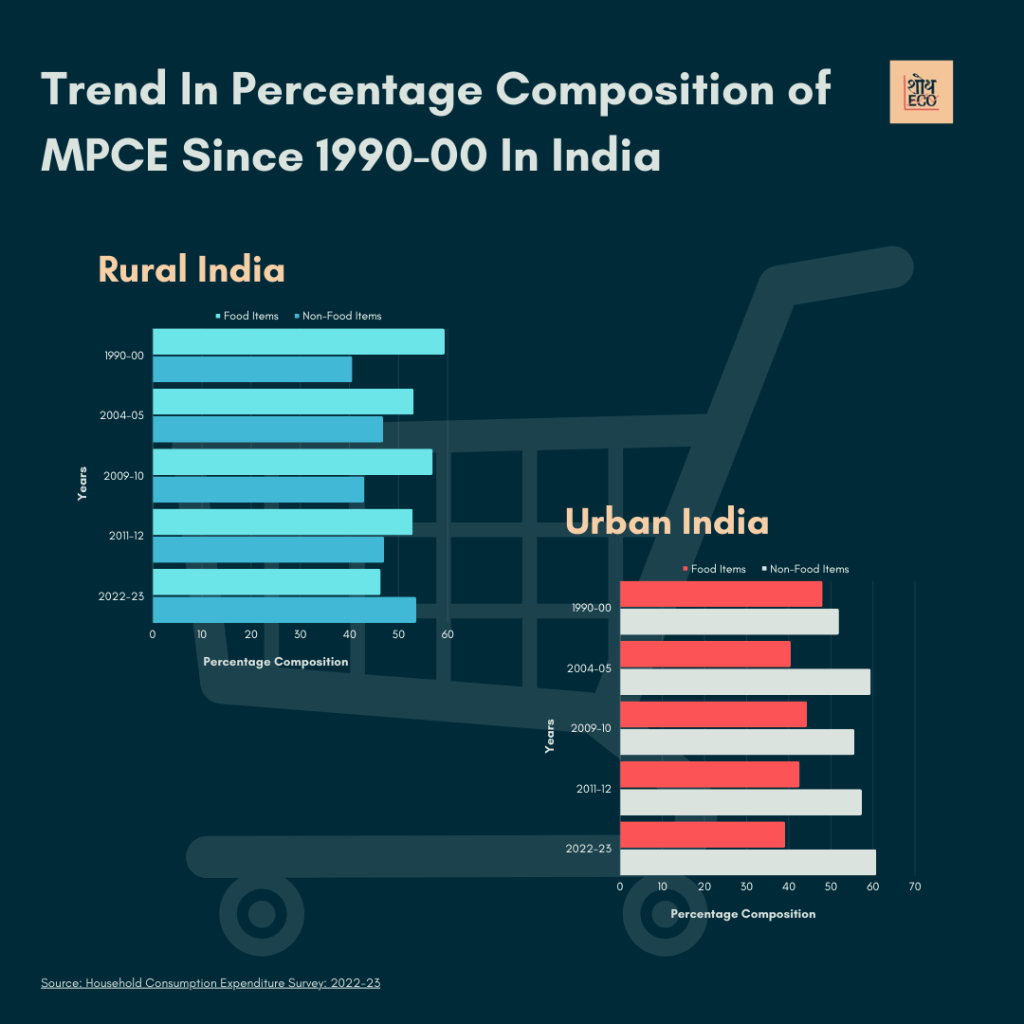
Noticeable thing in the above info-graph is the decreased share of expenditure on food items while expenditure on non-food items has increased. What does it tell us about the Indian economy? Well, according The CEO of NITI Aayog Mr. Subrahmanyam, lower spends on food items and higher spends on non-food items indicate that people are earning more and need to spend a lesser share of their income on food.
“It’s not that consumption levels of food are going down in absolute terms, but the relative spending on food is declining while consumption of products like TVs, fridges, mobile phones and cars have increased. This not only means there is a change in incomes for the better, but also a change in lifestyles,”- Mr. Subrahmanyam
To summarize, we can see changes in the trends of consumption expenditure in India. Many experts are of the opinion that the reduction and shift in the consumption of food items will also reduce the CPI(headline) inflation in India as much higher weightage is assigned to food items. Now the question remains whether government will assign lower weights to food items in their future estimates thus reducing the volatility of CPI(headline)?
Furthermore, some suggest that the RBI will get more room for growth given that CPI is rebalanced with a lower share of food and cereals. Such rebalance will possibly lead to a reduction in retail inflation as well. However I think it makes sense for government to wait till July when results of fresh HCES will be released.
 ShodhEco
One response to “What An Average Indian Consumes?”
Excellent article!! Very informative.
LikeLike