Author: Vaidehi Kedia
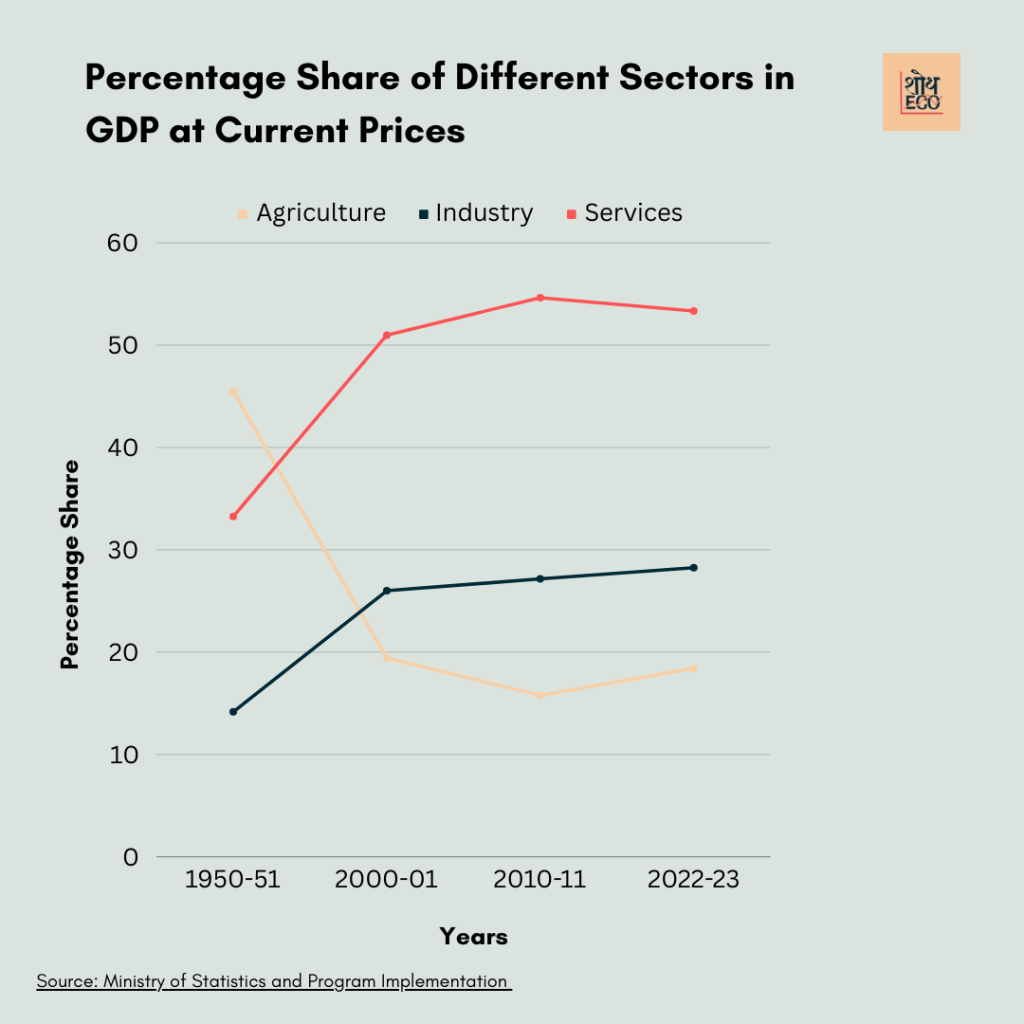
Why did India shift from the agrarian economy to service economy and looks like it skipped the manufacturing step?
This jump can be attributed to several factors.
The most critical one is our historical legacy. India has a long history of handicrafts and craftsmanship. But the British rule caused the downfall of manufacturing. We came to forefront as provider of cheap labour and raw material. These led to bringing in the service economy culture where we were the intermediaries. With manufacturing neglected through years, post independence India had to plan for its rise and how to bring in manufacturing industry.
India also possesses a comparative disadvantage over manufacturing due to noticeably high labor costs and infrastructural constraints. The abundance of skilled labor and english proficiency has made it well-suited for service industries such as IT, software development, business process outsourcing (BPO), and knowledge-based services.
Furthermore, globalization and technological advancements have also caused the jump. The rise of globalization and advances in information technology have facilitated the outsourcing of services to countries like India. Companies from developed nations have increasingly turned to India for services due to cost-effectiveness and quality provided. India’s government has actively supported the growth of the service sector through policies aimed at promoting IT and IT-enabled services, such as tax incentives, infrastructure development, and reforms to facilitate ease of doing business.
Also, India has faced infrastructural challenges such as inadequate transportation networks, power shortages, and bureaucratic hurdles, which have hindered the growth of manufacturing. In contrast, the service sector, particularly IT and BPO, requires less physical infrastructure.
The global trend towards a knowledge-based economy has further incentivized India to focus on services, where its educated workforce can excel.
While manufacturing still plays a significant role in India’s economy it has faced several challenges due to which it was not able to give such pronounced growth as service sector. There are several challenges that hindered India’s manufacturing sector’s growth. During colonial rule as mentioned above, India inherited an economy that is heavily geared towards raw materialistic exports under British rule, which limited the development of a robust manufacturing base. It also faced limitations in the infrastructure sector. Due to insufficient infrastructure, such as roads, ports, and power supply, hampered the growth of manufacturing industries.
Along with this, Protectionist policies also contributed to the boom. India adopted a policy of import substitution industrialization (ISI), which aimed to protect domestic industries from foreign competition by imposing high tariffs on imports. While this policy aimed to promote domestic industries, it also led to inefficiencies and lack of competitiveness. Also, the bureaucratic hurdles and licensing processes were cumbersome, discouraging investment and hindering the ease of doing business.
The abundance of unskilled and scarcity of semiskilled workers in India was one of the causes. There was a shortage of skilled labor in the manufacturing sector, limiting productivity and innovation.
Overall, these few are showcasing a combined effect and restraining the growth of the manufacturing sector in India. With the second five year plan and economic reforms starting in the 1990s, the significant efforts have been put forth to address these issues and foster manufacturing growth. The initiatives like Start up India, Skill India may provide a boost and bolster the sector.
 ShodhEco
One response to “The Jump”
Tremendous work… Vaidehi
LikeLike